
Start with the cloth.
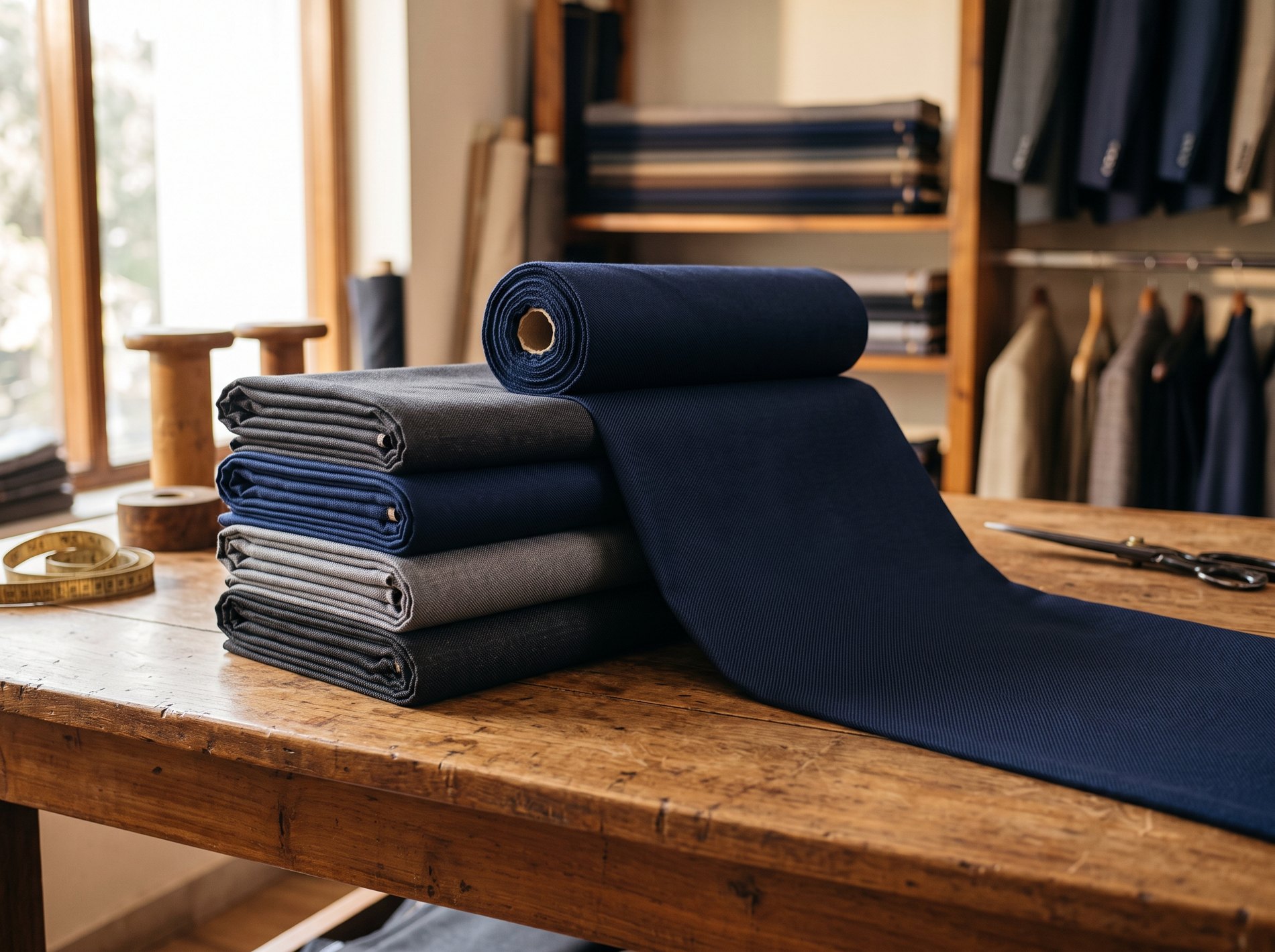
We keep a deep library of cloth, close to ninety per cent of it imported from Europe, and we'll happily spend an hour going through it with you.
Every commission starts with two questions: what cloth, and what weight. Get those right and the rest follows. Here is what we keep and what each of it is for.
Wool & worsted
The backbone of everything we tailor.
Worsted is combed wool spun into a smooth, strong yarn, and it is what most suits should be made of. It drapes, it holds a press, it recovers from creasing and it ages well. Weight matters here more than anything: the same cloth at 240g and at 380g are two different garments. For Chennai we live in the lighter half of the range, and we push hard towards high-twist weaves that let air move through the cloth.
Mohair & wool-mohair
The most underrated cloth for this climate.
Mohair comes from the angora goat, and its fibre is smooth-scaled rather than crimped like wool. That gives it three things we care about here: it breathes, it springs back from creasing instead of holding the fold, and it can take up around a third of its own weight in moisture before it feels damp on you. It also has a quiet sheen that reads beautifully in the evening. Pure mohair can be wiry, so the sweet spot is a wool-mohair blend, and kid mohair from the young goat is the finer grade. If you want one suit for Chennai weddings and evening functions, this is a serious candidate.
Cotton
Shirting, summer suits, and the trousers you actually live in.
Cotton covers more ground than people expect. At the fine end it is shirting: poplins, twills, oxfords and the voiles that make the most sense in this city. Heavier, it becomes chino and gabardine for trousers, or a soft summer jacket. Count is the number you will hear quoted, and higher is finer rather than automatically better. A 140s voile is a beautiful thing to wear in April and it will not take the punishment a 100s twill shrugs off.
Seersucker
Cloth that holds itself off your skin.
Seersucker is cotton woven so that some threads are held under more tension than others, which puckers the surface into ridges. Those ridges do the work: the cloth touches you in stripes rather than across its whole face, so air moves between the fabric and your skin. It also needs no pressing, because the crumple is the design. Usually striped, sometimes checked, and in this climate a sensible thing to own rather than an affectation.
Linen
The honest answer to a Chennai summer.
Linen breathes better than anything else we stock and it creases, and anyone who tells you otherwise is selling something. The creasing is the point: a linen jacket is supposed to look lived in. For weddings and daytime events in the hot months it is often the correct choice, and a linen blend gives you most of the comfort with rather less of the rumpling.
Khadi
Hand-spun, hand-woven, and built for humidity.
Khadi is spun and woven by hand, which is why no two lengths behave identically. The hand-loomed structure leaves small gaps between the yarns, so air passes through it continuously, and the cloth pulls sweat off the skin and lets it evaporate rather than holding it against you. In a humid coastal city that is not a small advantage. It carries a good deal of history with it as well, and it has come back into serious fashion for kurtas, bandhgalas and unstructured summer jackets.
Silk & silk blends
For the garment that has to photograph well.
Silk in a blend does something no pure wool can: it puts a quiet light into the cloth that reads beautifully under a camera. Wool-silk and wool-silk-linen are our usual answer for a reception jacket or an evening suit that is not black tie. The silk content also brings the weight down, which matters in a crowded room in May.
Indian silks
Kanchipuram is seventy kilometres from this shop.
India produces four distinct silks: mulberry, tussar, eri and muga. Mulberry is the cultivated one, strong and even, and it is what Kanchipuram silk is woven from, up the road in Tamil Nadu, with zari brought in from Surat and the body and border woven on separate shuttles then interlocked. Tussar is a wild silk from worms feeding on forest trees, textured and honey-coloured, often left undyed. Raw silk keeps the sericin that is normally boiled away, which is what gives it that slubbed, nubby surface. For sherwanis, bandhgalas and festive kurtas these are frequently the right cloth, and being where we are, we have no excuse for not knowing them properly.
Brocade & zari
Occasion cloth, and the reason a sherwani reads as a sherwani.
Brocade is figured cloth where the pattern is woven in rather than printed on, traditionally with supplementary weft threads carried across the back. Zari is the metallic thread that lifts it. The weight and the stiffness are features, not faults: a sherwani or bandhgala needs cloth with enough body to hold the silhouette without the tailoring fighting it. We will steer you on scale, because a motif that looks right on a hanger can look very different across a shoulder.
Velvet
For evening, and for the winter wedding.
Velvet is a pile weave, cut so the fibre ends stand upright and catch light from every angle, which is exactly why it photographs the way it does. Silk velvet is the finest and the most expensive; cotton and blended velvets are more practical and take tailoring well. It is warm, so we use it for evening jackets, bandhgalas and December weddings rather than anything worn in daylight in April.
Denim & cotton bottomweights
The trousers that get worn more than any suit.
Bottomweight is the trade word for the heavier cotton cloth that trousers are cut from: chino, gabardine, drill, moleskin and denim. None of it is suiting and we will not pretend otherwise. What it is, is the most-worn thing we make. A pair of trousers cut to your own rise and seat in a good bottomweight will get more wear in a year than a suit gets in five.
Cashmere & the fine fibres
Beautiful, expensive, and mostly wrong for this city.
Cashmere, vicuna, camelhair and alpaca sit at the top of the fibre market. We will be straight with you: almost all of it is cold-country cloth, and a cashmere overcoat in Chennai is an ornament. Where it earns its place is the one very good jacket for travelling, or a fine wool-cashmere blend in a light weight where you get some of the handle without the heat.
Blends & performance cloth
What most Indian suiting is actually made of.
Poly-viscose and poly-wool blends are the largest part of the Indian market and they are not a compromise so much as a different set of trade-offs. They hold a press, resist creasing, dry fast and survive daily wear, which in a hot and humid city are real virtues. They will not drape or breathe like a good worsted and they will not age the same way. For uniforms, for a first suit, and for the trousers that go to work every day, they do the job well.
Linings
The half of the jacket nobody sees and everybody feels.
A jacket is only as comfortable as what sits against your shirt, and this is where a lot of tailoring quietly fails in hot weather. Cheap polyester lining traps everything. We use cupro, sold as Bemberg, which is made from cotton linter and breathes properly: it wicks moisture, it does not cling, and it does not build static. For the hottest months we will also half-line or quarter-line a jacket so the back is open, which changes how a garment wears far more than most customers expect.
British, Italian and Indian houses sit behind those fibres, each with its own page explaining what they weave and when we would put you in it.
See all the mills we source fromCloth that survives a Chennai afternoon.
Plenty of beautiful cloth is wrong for this city. We push people towards high-twist, open weaves and tropical-weight wools that let air through and still look sharp at seven in the evening. If what you've picked won't survive May here, we'll say so.