
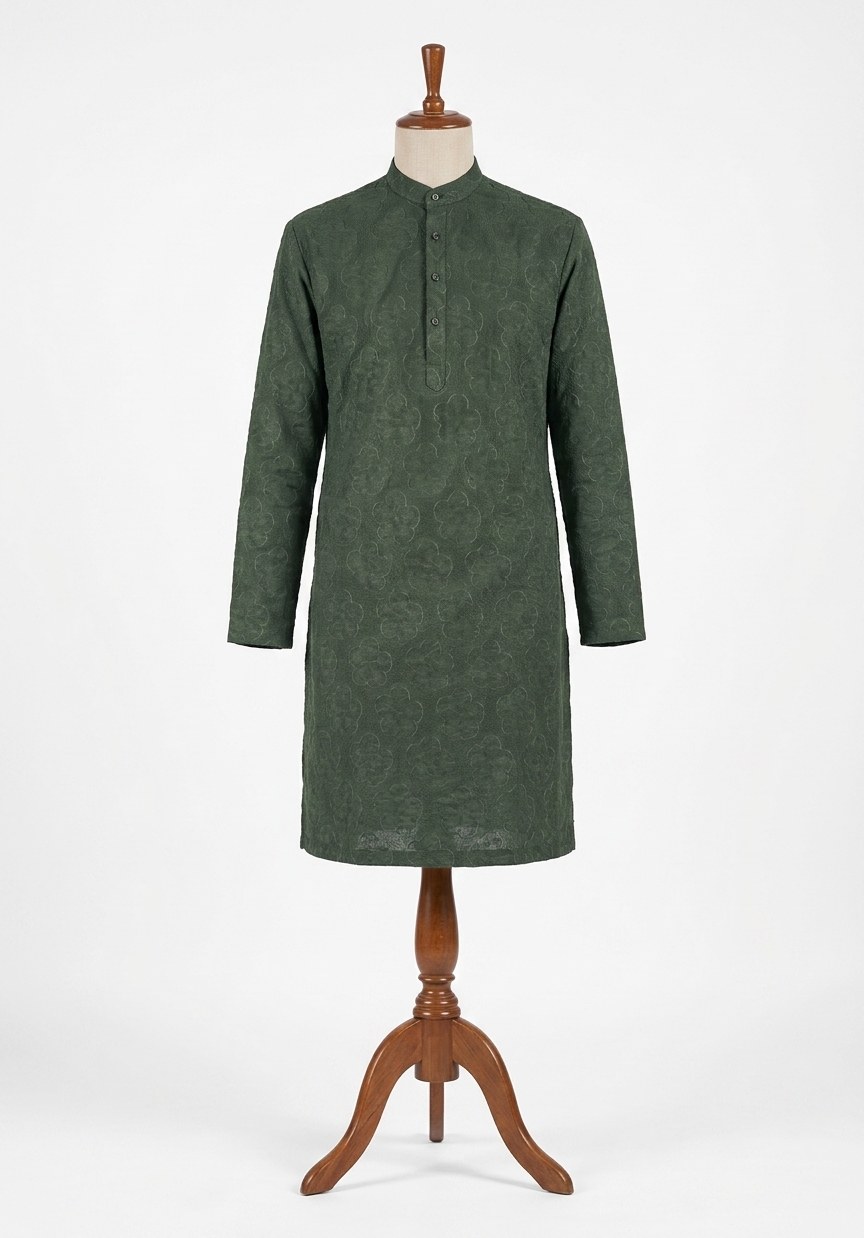
The kurta holds up the whole Indian wardrobe. Diwali and casual Friday, a family lunch and a sangeet, a Sunday at home and a temple visit, all covered by one garment in a way no Western piece comes close to matching. A bespoke kurta from Sellers starts with your measurements and is made in the cloth you choose, cotton, linen, silk or a silk blend, to the length, collar and sleeve you prefer. It sits across the shoulders and the chest the way ready-made kurtas almost never do, and it will still be in your cupboard in five years. If you would rather buy one off our rail, our tailors will alter it to the same fit, usually within the week.
Why fit still matters on a loose garment
Because a kurta hangs loose, people assume the fit is negotiable. It isn't. Too wide at the shoulder and the whole thing looks borrowed. Too narrow across the chest and you spend the evening adjusting it. What you want is a kurta loose enough to move in freely that still looks like it was made rather than grabbed off a pile.
Four measurements decide it: shoulder width, chest, shoulder-to-hem length, and sleeve length. Every one of those varies enough between men that any single standard size will be wrong on most bodies in at least one of the four. Cutting to your measurements fixes all four at once, which is how you end up with something comfortable that still looks deliberate.
Collar, length and closure: the choices
The band collar, or Mandarin collar, is the common one: a low stand of 1.5 to 2 cm that gives a kurta its familiar Indian outline. The V-neck kurta, opening at the front with no collar at all, is easier and reads as home wear. The round or jewel neck, collarless with only a small opening, is the simplest of the three and the most casual.
Length changes the garment more than anything else. A short kurta finishing at mid-thigh is the everyday one, worn over jeans or slim trousers. A long kurta ending at or just below the knee is dressier and right for festive and semi-formal evenings. Take it down to the calf and you are approaching achkan and sherwani territory, which belongs to formal occasions only.
Then the closure. Side slits running from the hem up to the hip are traditional and let you move properly, which matters when you are sitting cross-legged for an hour. A straight hem with no slit is the more contemporary city cut. The placket, where the button run extends part-way down the front from the collar, is the detail that ties a kurta back to its craft origins, and it's worth asking for.
Cloth: cotton, linen, silk and everything between
Cotton is what most kurtas should be made from. A fine 60s or 80s voile, or a handloom cotton in a close weave, survives Chennai's heat, washes without drama, and takes you from a Saturday morning to a small family function. For everyday wear, nothing else comes close.
Linen has its own case. It stays cool, its creases look lived-in rather than careless, and it has a hand that separates it immediately from cotton or silk. In natural, white or the earthier tones it suits relaxed occasions and creative offices, and it ages better than almost anything else on our shelves.
Silk, whether raw silk, Tussar or fine plain silk, is for festivals and formal evenings. A white or ivory plain silk kurta is the most useful festive thing you can own: put a bandi, a Nehru jacket or a sherwani over it and the silk underneath does its job quietly every time.