
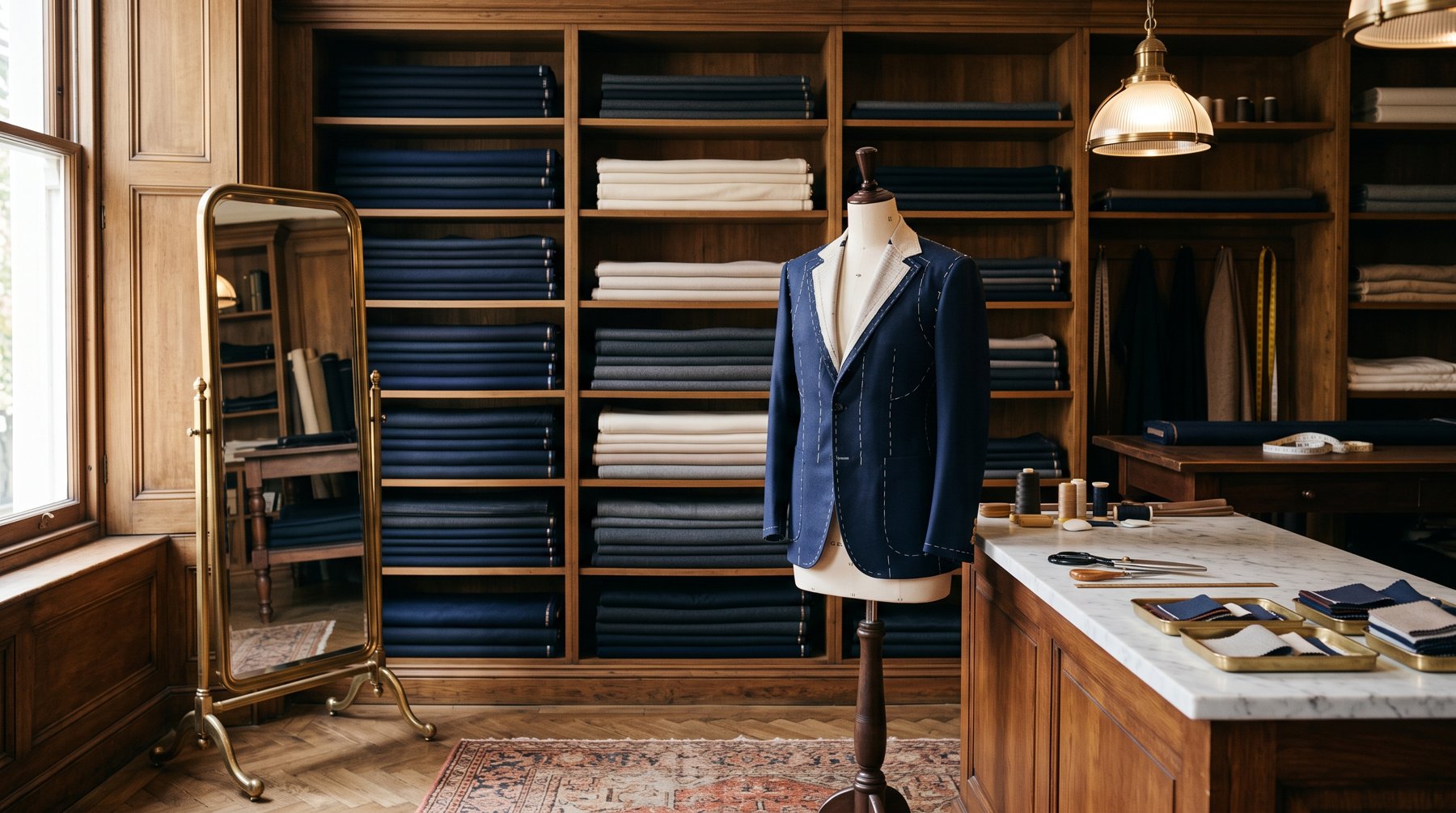
People are wary of tailoring shops, and some of that is the trade's own fault — vague prices, vague timelines, promises nobody keeps. So here is everything we get asked at the counter, answered the way we'd answer it if you were standing in front of us. If yours isn't here, call or walk in. Conversations are free.
What does it cost?
There isn't one number, and any shop that quotes you before knowing your cloth is guessing. Three things move it: the cloth you pick, how the garment is built, and how complicated it is.
A two-piece suit can run from a solid, practical garment in a good wool right up to a fully canvassed one in a Super 150s from Scabal or Dormeuil. Shirts, trousers, ethnic wear and coats work the same way — cloth and construction set the price, not a label.
What we can promise is that the price reflects what's actually in the garment: hours of cutting, hand-finishing and fitting. And if the budget is tight, say so. We have rails full of Van Heusen, Arrow, Louis Philippe and Raymond, and our tailors will fit any of it properly. That's often the smarter buy, and we'd rather tell you than take the bigger order.
Come in, tell us what you need, and you'll get a real number the same day. No obligation attached to it.
How long does it take?
A suit or jacket runs four to six weeks from first visit to collection. A shirt is two to three weeks. Ethnic wear — sherwani, bandhgala, achkan — takes four to eight weeks depending on cloth and how much embellishment is involved. Alterations on something bought here are usually three to five working days.
Those numbers aren't padding. After measurements and cloth, your pattern gets drafted — not a size medium adjusted, but a pattern drawn from your figures. Then cutting, machine work, hand-finishing, a fitting midway, adjustments, finishing, and a final fitting before it's pressed and handed over.
If you have a date — a wedding, a function, a flight — tell us at the first visit. We'll say plainly whether it's achievable. If we need to move you up the queue we'll tell you that too. We don't promise dates we can't hit.
For genuinely urgent things, ring us. We can sometimes compress simpler garments, and when we can't, the honest answer is usually to buy off the rail and let us fit it in three days.
How many fittings?
Two as standard for a suit — one on the basted shell, one at the end before delivery. If your fit is complicated we'll add a third. That's not unusual and it doesn't cost extra.
The middle fitting is the important one. At that point the garment is assembled in your cloth but unfinished — seams open, collar pinned, sleeves hanging rather than set. That's when the fit gets read and corrected, with chalk marks straight onto the cloth. It's also when we settle length, pocket placement and any details you've been undecided about.
The last fitting is a check. The garment is finished and pressed and you wear it the way you'll wear it out. If something's off, we fix it before you leave. We don't send you home and ask you to come back another day for a hem.
Shirts need one fitting for a returning customer, two for a new one. Embroidered ethnic wear usually wants three, because the shape shifts as the layers and the work go on.
What's the difference between bespoke and made-to-measure?
People use the words interchangeably. They aren't the same thing, and knowing which you're buying is worth real money.
Bespoke means a pattern drawn from scratch for your body. No existing block. That pattern stays on file and every future garment comes off it. You're fitted on a basted shell partway through, so everything can still be moved.
Made-to-measure means an existing house pattern adjusted to your measurements. A 40 chest block with a centimetre added here and a seam nipped there. Much better than a rail, still built on a foundation drawn for an average body.
The gap shows up in the awkward places: shoulder pitch, upper back, the balance between front and back length, the angle the sleeve hangs at. An adjusted block never quite settles those. A drafted pattern starts in the right place.
We do both here, plus alterations on ready-made, and we tell you which one you're getting before you pay for it. That last part is the bit the trade tends to skip.
What happens on a first visit?
It's unhurried and there's no obligation. Sixty to ninety minutes usually, longer if you're ordering several things or if the cloth conversation runs on, which it often does.
We start with what you need it for. A suit for daily office wear is a different conversation from a suit for one specific wedding. Building a wardrobe from scratch is different again. There are no wrong answers — we're trying to understand your week, not sell you something you'll never wear.
Then cloth. Bunches from Holland & Sherry, Scabal, Dormeuil, Vitale Barberis Canonico and others come off the shelf, we pull the right weights for the season and the purpose, explain what each one does, and put them in your hands. This is usually the longest part, and it should be.
Then measurements — eighteen to twenty-four of them depending on the garment. That's the start of your pattern, and it stays on file for everything you order afterwards.
Finally the details: lapel, pockets, lining, buttons, a monogram if you want one. Then a timeline and a price. You leave knowing exactly what's being made and when it'll be ready. Nothing left vague.
What cloth do you carry, and how do I choose?
Wool, wool blends, linen, cotton, silk and specialty weaves, mostly from the British and Italian mills. For suiting: Holland & Sherry, Scabal, Dormeuil, Vitale Barberis Canonico. For shirting: Thomas Mason, Alumo, David & John Anderson. For ethnic wear: silks, brocades, chanderi and structured wools from specialist suppliers.
Choosing is simpler than it looks. Three things matter — weight (how it hangs and how it breathes), fibre (the hand, the sheen, how long it lasts) and weave (surface and pattern). For Chennai, a tropical worsted or a fresco in fine merino is the sensible year-round choice. Flannel and heavier worsteds are for the short cool spell or for offices with aggressive air-conditioning. Linen is wonderful in the heat and creases the moment you sit down, which is fine for a relaxed jacket and less fine for a day of meetings.
We'll steer you. Twenty-eight years of watching what survives a Chennai April counts for something. If you walk in with a picture of a heavy English flannel glen plaid in the middle of May, we'll tell you to come back in November.
Most of what we use is British or Italian. The rest is carefully chosen Indian cloth, particularly for ethnic wear, where the silks and brocades from Varanasi and Kanchipuram have no European equivalent worth having.
Do you make Indian ethnic wear?
Yes, and plenty of it. Sherwanis, bandhgalas, Nehru jackets, bandis, kurtas, achkans and Jodhpuri suits. It isn't a sideline — it's the same tailoring applied to different garments, with the same pattern work and the same fittings.
A sherwani is genuinely hard to fit. The long line of the coat, how it sits at the shoulder and chest, the relationship between collar and neck — get any of it wrong and it shows from across a hall, exactly like a badly fitted suit does. We treat both with the same seriousness.
For weddings, where the groom's sherwani or bandhgala carries the whole outfit, we plan three fittings and start well ahead of the date. We've dressed grooms and their families from across Tamil Nadu, Andhra Pradesh and Kerala, and a fair number who fly into Chennai specifically to have it made.
Cloth options include raw silk, dupion, velvet, chanderi, brocade, and structured wool for bandhgalas and Nehru jackets meant for formal wear. We'll go through all of it with you.
Do you make womenswear?
Yes. Suits, blazers, trousers and structured evening jackets. It's been part of the shop for years, and the process is identical to the menswear: a pattern from your measurements, cloth chosen for the purpose, two fittings before it leaves.
The one we make most often is the working suit — a canvassed blazer with a matching trouser. A blazer cut for you sits across the shoulder and chest in a way a rail blazer simply can't, and the trouser is cut to your actual waist-to-hip ratio rather than an industry average. Most women notice the difference the moment they put it on.
We also carry ladies wear on our ready-made rails, so a lot of visits end up being a bit of both — something made, something bought and altered. If you're thinking about a saree blouse as part of a larger order, ask us; we take a limited number and discuss them one by one.
Will you alter something you didn't make?
Yes, most of the time. Sleeves shortened, chest taken in, trouser waists adjusted, hems redone — bring it in wearing it if you can. We do decline work occasionally, when the original construction won't hold the alteration. A fused jacket being let out at the chest will bubble along the new seam, and we'd rather tell you than take your money for something we can't stand behind.
Anything bought from our own rails is altered here as part of the purchase — same tailors, usually the same week. That's the main reason people shop with us rather than at a brand showroom that sends alterations out to a third party.
And anything we made, we look after indefinitely. Bodies change; we keep your pattern and can adjust both the pattern and the garment. That's the practical advantage of having a tailor rather than just a shop.
I've ordered before. What happens next time?
Easier. Your pattern is on file. If nothing much has changed, or only needs a small correction, it goes straight to cutting. One visit for a fitting midway, one to collect. The result is good immediately because the pattern has already been refined on you.
If your shape has changed a lot since last time, we re-measure and update the pattern. That's routine and it doesn't mean starting again — adjusting an existing pattern is nearly always quicker and better than drawing a new one.
Plenty of our customers have been ordering for ten or twenty years. Their wardrobes are largely from here. Watching one build up over time, everything cut in the same house style, is one of the quiet pleasures of staying with the same shop.
Do I need an appointment?
No. Walk in whenever we're open and someone will see you; if we're mid-fitting we'll ask you for ten minutes. Booking ahead is worth it for a first bespoke order, for weddings, or for a large order, because it means a fitter to yourself with the right bunches already pulled.
Monday to Saturday, 11am to 9.30pm, at 3 Sardar Patel Road, Adyar, Chennai 600020. There's street parking. From Nungambakkam it's about twenty minutes, from Anna Nagar around forty. We're five minutes from the Adyar junction.
Book by phone, WhatsApp or email — details are on the visit page. First visits are free and carry no obligation whatsoever.
How should I look after it?
Looked after reasonably, good clothes last decades. The rules are simple and mostly about not overdoing things.
Rest it. Wool needs a day between wears to recover. Wear the same suit daily and it ages fast. Two in rotation last far longer than one worn every day.
Brush it. A soft clothes brush after each wear lifts dust off before it grinds into the weave. Thirty seconds, and it buys you months between dry cleans.
Hang it properly. Shaped wooden hanger, never wire. Cloth garment bag for storage, never plastic — plastic traps damp, and in Chennai that means mildew.
Dry clean rarely. It strips the natural oils out of wool. Once or twice a season is plenty for most people. Spot-clean and air it in between.
Press with a cloth in between. Never an iron straight onto worsted; it leaves a permanent shine. Better still, steam from a couple of centimetres away. After travel, hang it in the bathroom while a hot shower runs.
If something goes — a lining, a button, a seam — bring it back. Small repairs on garments we made are usually free, and we'll happily look at things we didn't make too.