
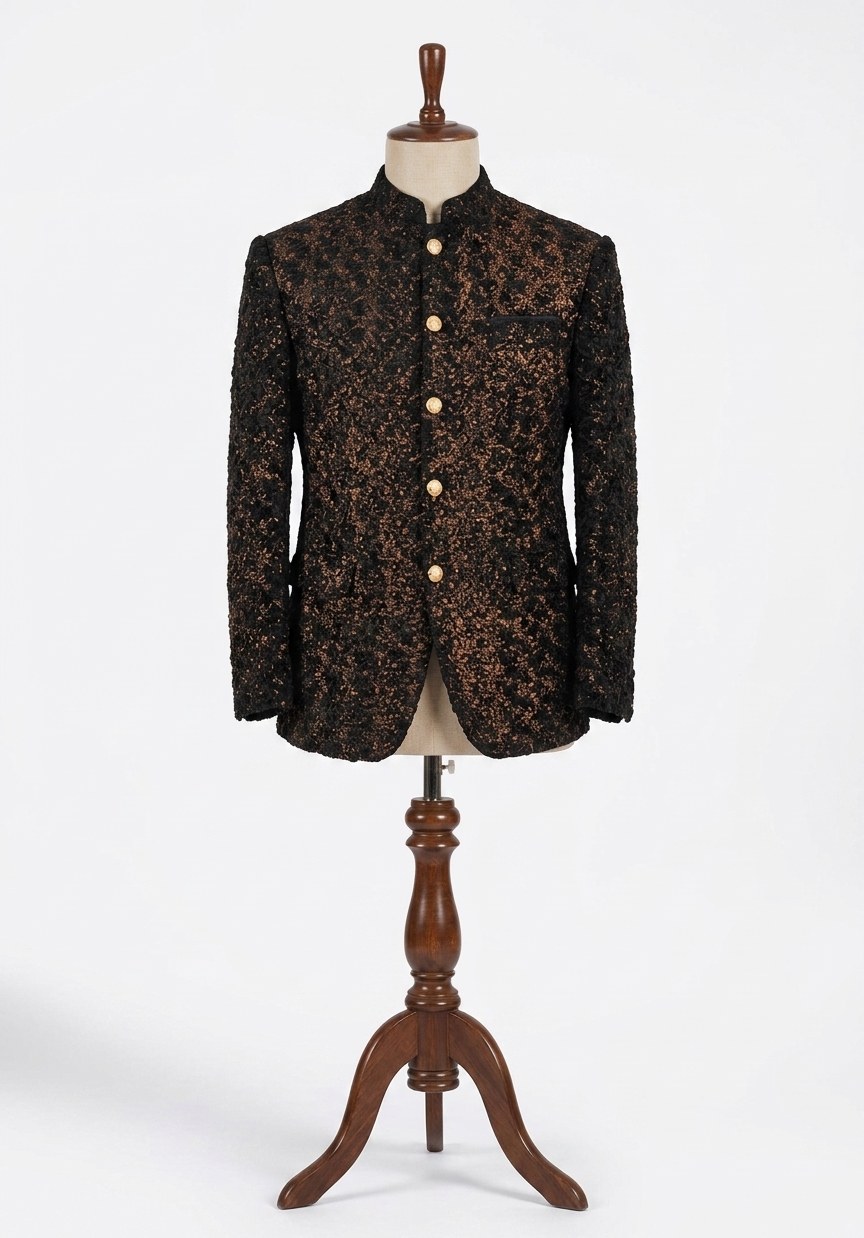
Every groom we meet has had this argument with himself, and usually with his mother too. Suit or sherwani. There's no correct answer waiting to be found, only the right answer for your ceremony, your family, your partner's outfit and your own skin. Work through those four in order and the choice tends to make itself. Here's how we take grooms through it at the shop, before anybody picks up a tape measure.
The four things that actually decide it
The ceremony format carries the most weight. A traditional Hindu ceremony at the mandap is about as culturally specific as Indian life gets, and a Western suit there says something whether you mean it to or not. Most families at a traditional ceremony expect Indian formal wear on the groom: sherwani, achkan or Jodhpuri suit. At a registrar ceremony, a church wedding, or a garden ceremony run Western-style, a suit needs no defending.
Your partner's outfit comes next. A traditional lehenga or Kanjivaram on one side and a Western suit on the other reads as two different weddings in the same photograph. A contemporary gown and a good suit read as a pair. The two outfits have to work together, not just separately.
What the families expect varies a great deal by community. In some Tamil families a suit at the muhurtham would need explaining. In cosmopolitan and Anglo-Indian families nobody would blink. Find out what both sides are picturing before you commit, because there's usually a choice that keeps everyone happy.
What you're comfortable in matters more than grooms expect. If you've never worn Indian clothes in your life, you'll look like you're in costume, and the camera picks it up. If your Indian identity means a lot to you, a suit on the day may nag at you afterwards. Choose from that, not from what a cousin wore last winter. If you like both equally, nothing stops you wearing one at the ceremony and the other at the reception, which is what a good number of the grooms we dress end up doing anyway.
The Jodhpuri suit, when you really can't choose
If you're stuck, the Jodhpuri suit usually settles it. It's cut and structured like a Western jacket with matching trousers, but the stand collar and the detailing make it unmistakably Indian. From across the hall it reads as a suit. Up close it reads as ours. For a groom moving between both worlds all weekend, that's a very useful garment to own.
We make Jodhpuri suits in the same cloths as our Western suits: fine wool suiting, silk-wool blends, sometimes a good silk. Fitted the same way too. The stand collar takes its own pattern work, quite different from a lapel jacket, and it's work our tailors do week in and week out. Done right, it's one of the sharpest things a groom can wear. It also earns its keep after the wedding, which a heavily worked sherwani never manages. A plain Jodhpuri in navy or charcoal will come out again for family functions for the next ten years.