
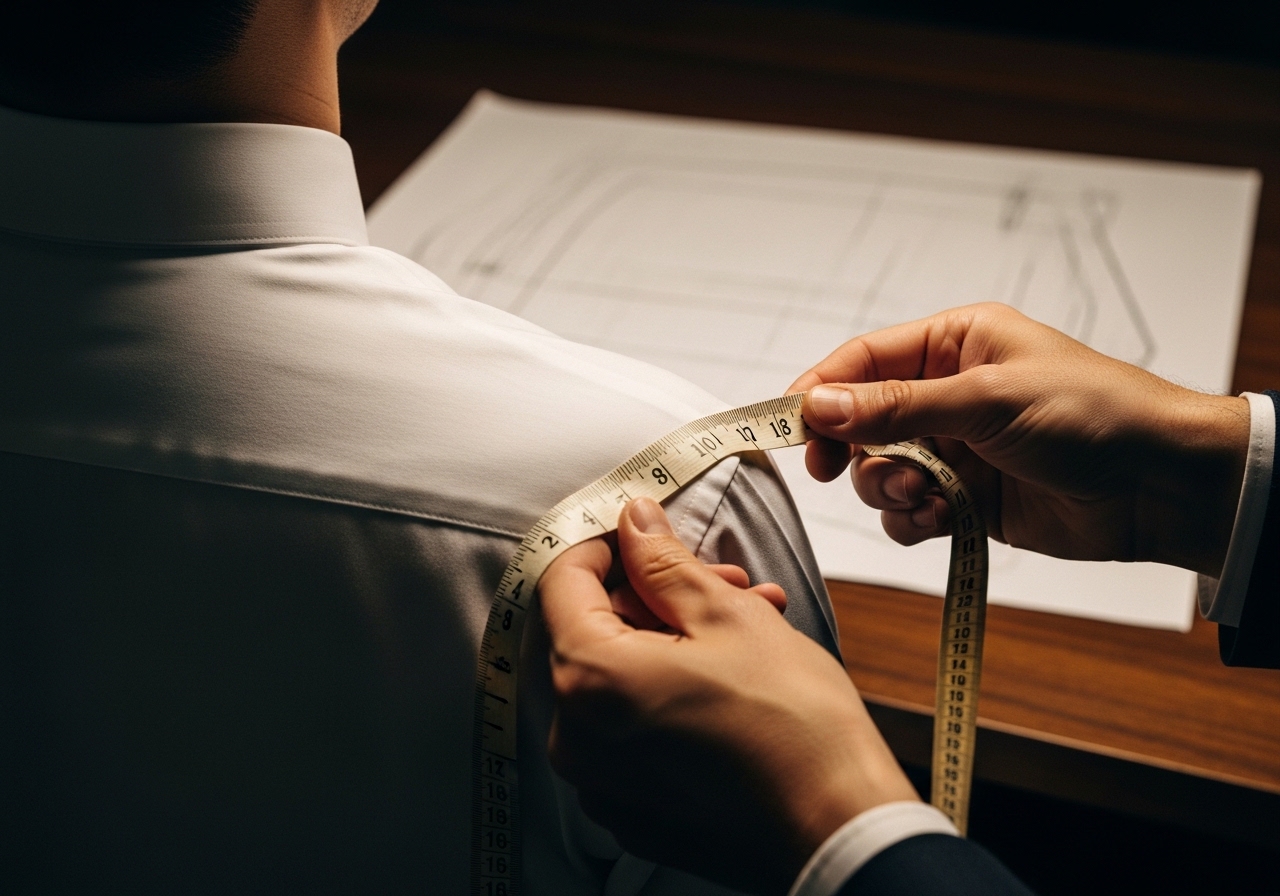
Most people have never worn anything that genuinely fits them. Ready-to-wear is cut for an average, and nobody is average, so you get used to a jacket that pulls somewhere and a trouser that sits wrong when you sit down. You know what a suit looks like in a photograph; you may never have felt what one is supposed to feel like on your own shoulders. This is what we look at, point by point — and much of it can be corrected on something you already own, so read it with your own wardrobe in mind.
A jacket — seven things to check
1. The shoulder. The seam where shoulder meets sleeve should land exactly at the edge of your shoulder. Too wide and the sleeve bunches at the armhole; too narrow and it drags across the upper chest and stops you reaching forward. This one can't be meaningfully moved after the jacket is made, which is why it decides everything else. When you're buying off a rail, check this first and ignore the rest until it's right.
2. The collar. The jacket collar should follow your shirt collar, sitting about a centimetre below it, with no gap behind your neck. A collar that lifts away means the back balance is wrong. A collar that digs in is sitting too high. Both are pattern problems.
3. The chest. Buttoned, the front should lie flat — no pulling, no X-shaped creases at the button. You should be able to bring your arms forward without the back straining. Equally, there shouldn't be so much room that it reads boxy.
4. The waist. A good jacket follows you: wider at the chest, taken in at the waist, easing out again over the hips. How much suppression is personal taste within limits — cut it very close and it looks sharp but restricts you; cut it straight and it hides the shape you have. We settle this at the first conversation, before anything is drafted.
5. The sleeve. Length should leave a centimetre or so of shirt cuff showing. The sleeve should hang straight with no twist, and the sleeve head should be smooth rather than puckered.
6. The length. Part function, part fashion. The old rule is that the hem covers your seat; another is that jacket length roughly equals sleeve length. Current fashion runs shorter. We'll talk it through rather than impose one, because you're the one wearing it for the next decade.
7. Inside. The lining shouldn't be visible from the front, and the inside should sit smoothly against your shirt without ridges telegraphing through to the outside.
A trouser — four things that matter
1. Waist and seat. The waist should stay up without a belt doing the work. The seat should let you sit without pulling across the back, but not hang loose underneath. Waist, seat and rise all pull against each other, and this is where ready-to-wear compromises hardest.
2. The rise. The distance from crotch to waistband. Too short and it's uncomfortable the moment you sit, with tension across the front. Too long and there's spare cloth bunching under the waistband. The right rise depends on your torso, how you carry weight, and where you like your waistband to sit.
3. Thigh and knee. Close enough to look tailored, loose enough to walk. Horizontal creases across the thigh mean it's too tight. Loose vertical folds at the knee mean the taper is wrong for your leg.
4. The break. The little fold where the hem meets the shoe. One soft break sitting on the shoe is the traditional look and gives a clean line from hip to floor. No break reads more modern. Both are fine; tell us which you want and bring the shoes.
A shirt
The shirt sits against your skin all day and it's the garment people most often get wrong. The points to check: the collar should close without gapping or choking — one finger between collar and neck when buttoned; the shoulder seam follows the same rule as a jacket; the chest should let you move without dragging across the back; the cuff should sit at the wrist bone so it shows below a jacket sleeve; and the body should be long enough to stay tucked when you raise your arms.
Getting these right fixes the familiar complaints — the collar that's tight at the neck and somehow loose at the points, the shoulder that pulls, the body that balloons at the waist. Whether we cut it for you or you picked an Arrow off the rail and we take it in, the test is the same: when a shirt fits, you stop noticing it. That's the whole point of a shirt.
What we measure
For a jacket, at least eighteen measurements: chest at the widest point and again high under the arm; waist; seat; back width; back length to waist and to seat; front length; shoulder; arm length; upper arm; neck. Then the diagnostic ones — back slope, shoulder angle, and any difference between your left and right sides, which almost everyone has.
For trousers: waist, hip, seat, thigh, knee, calf, front and back rise, inseam and outseam.
For shirts: neck, chest, waist, seat, shoulder, sleeve, cuff and length.
All of it goes into your file and becomes your pattern. If you've been measured elsewhere, or you have a garment you love, bring the numbers or the garment — both are useful as a cross-check. We'll still measure you ourselves and work from our own figures, because we're the ones who have to answer for the result.
What to bring to a fitting
Wear the shirt and the shoes you'll actually wear with it. The shirt collar determines where the jacket collar sits; the heel height determines the trouser length. Turn up in different shoes and we're fitting to the wrong floor.
If you carry things in your pockets — wallet, phone, spectacle case — bring them. A loaded jacket hangs differently from an empty one, and a jacket fitted empty will pull once you fill it.
Bring whatever goes underneath, too. A waistcoat, or a heavy sweater if it's an overcoat. Fit a jacket without the waistcoat it's meant to cover and it'll be tight the first time you wear them together.