
Clothing is one of the most wasteful industries on earth. Cheap garments made in enormous numbers, worn a handful of times and thrown out — the cost of that is well documented by now and none of it is good. Our end of the trade works the other way round, not out of virtue but because of what the job is. Something cut for one person, in cloth they chose, built to last, doesn't get binned after three wears. Here is what we actually do, and what we won't pretend to.
Making things that last is the whole argument
The most useful thing we do for the environment is make garments that stay in use. A good suit in decent wool, cared for reasonably, gives you fifteen or twenty years. In that time it replaces four or five worse suits that would have been bought, worn out and thrown away. All the water, energy, transport and synthetic fibre behind those four or five is simply never spent.
That's not us claiming to be green. It's an observation about quality and time, and the arithmetic that follows from it. Less, made better, is less waste. It always has been.
We build for that. Canvas rather than fusing, hand-stitching where the stress goes, buttons and findings that don't crack in the wash — chosen because they last, not because they're cheap to fit. A garment built this way can be repaired, let out, taken in and re-lined as your life changes. It's meant to stay in the cupboard, not pass through it.
Where the cloth comes from
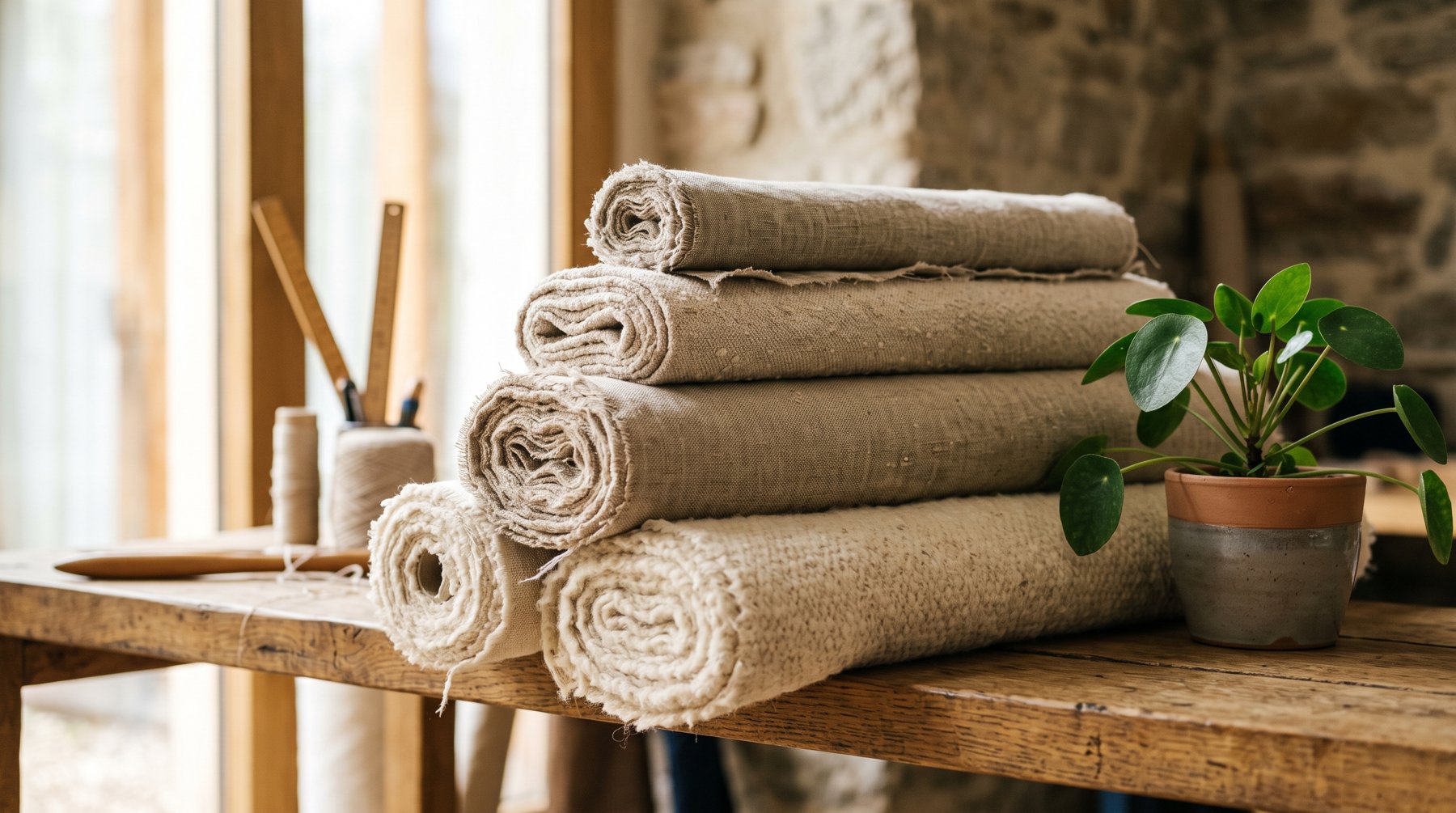
Most of our suiting comes from British and Italian mills — Holland & Sherry, Scabal, Dormeuil, Vitale Barberis Canonico — houses that have been spinning wool for generations. They buy merino mainly from Australia and New Zealand, process it in Britain and Italy, and sell in small quantities to shops like ours. It's a long supply chain, but one where quality is the point at every stage, which tends to come with more care than a volume operation can afford.
We don't use synthetic suiting. We don't fuse jackets. We don't put in the cheap imitation-silk lining that shreds in two years. Those calls were made for quality reasons first, but they happen to be the better ones environmentally too: natural fibres break down, good cloth doesn't need replacing, and a garment that lasts doesn't feed the throwaway cycle.
For ethnic wear we buy silks from weavers in Tamil Nadu and Varanasi — small workshops, families who have woven the same way for generations. Keeping that work viable matters. A craft that can support the people doing it doesn't have to be industrialised to survive.
How we work
We're one shop with one bench. Only so many garments leave here in a week, because each is cut by hand, fitted individually and finished at a pace that can't be compressed. That's not a sustainability strategy, it's just what the work requires — you can't rush a commission without damaging it, so the volume takes care of itself.
Offcuts get used: pocket bags, internal facings, small parts you never see. Larger pieces of expensive cloth are kept aside in case the customer wants a matching waistcoat or a second pair of trousers later. Nothing is cut speculatively; every length is bought for a particular person's garment.
Repairing is the real work
We mend what we make, and plenty of what we didn't. A lining gone at the armhole, a suit that no longer closes, a jacket worn through at the elbow, a shirt from our own rails that needs the sleeves shortened again — bring it in. Nine times out of ten it can be fixed, and fixing it is cheaper for you and better for everything else.
Keeping a garment going rather than replacing it is the oldest sustainability position there is, and the only one a tailor is genuinely qualified to hold. We've re-lined suits older than some of our staff. We've moved the same waistband out and back in twice in a decade for the same customer. The garment is still being worn. That's the whole idea.
What we won't claim
We're not going to tell you a suit is carbon-neutral, or that our supply chain has no impact, or that the wool arrived without a sheep or a field being involved. None of that would be true of any textile, and saying it anyway is how the word sustainability got worn out in the first place.
What we will say: we make a small number of garments, we build them to outlast the average by a long way, we use natural cloth from mills we can name, and we repair rather than push a replacement. If that reads as a decent way to run a clothing shop, good. If it falls short of what you're looking for, fair enough — we'd rather say what we actually do than perform something we haven't earned.