
Price is the first thing most people want to know, and that's fair enough. The reason there's no price list on this page isn't coyness. It's that a number for a bespoke suit means nothing until you know the cloth, how it's built and how complicated the garment is. The same commission can sit at very different prices, and the gap is real — you get more for the extra. Here is what actually drives it. And if the budget is fixed, remember we also have rails full of Van Heusen, Arrow, Louis Philippe and Raymond, altered here to fit you.
Three things decide the price
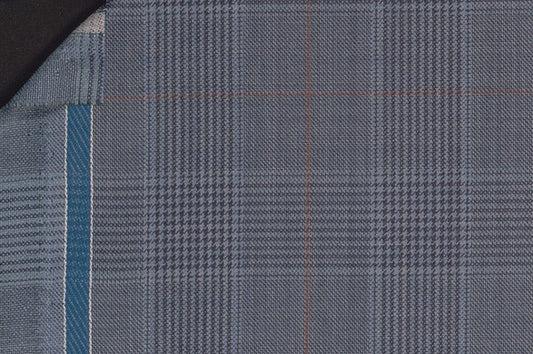
The cloth. Usually the single biggest line, and the one worth spending on, because the cloth is permanent. A good Indian mill wool makes a proper suit. A fine Super 150s from Holland & Sherry or Scabal makes a better-looking one that drapes differently, holds a press longer and still looks right in ten years. Both are honest choices. The difference in price is a difference in what you get, not a markup.
How it's built. A canvassed jacket with padded lapels, hand-worked buttonholes and a hand-set collar takes hours that a fused jacket doesn't. Fusing is glue: faster, cheaper, and over time it separates and the front starts to bubble. We use full or half canvas on every jacket we make. That cost is in the price and it isn't something we'll cut out to hit a number.
How complicated it is. A plain two-button jacket is quicker to pattern and cut than a double-breasted one with peak lapels and unusual pockets. A standard collar is quicker than a bespoke one. An embroidered sherwani carries the embroiderer's cost on top of ours. Complexity moves both the price and the calendar.
What the price covers
Every bespoke order here includes the pattern drafted from your measurements, a basted fitting in your actual cloth, the full construction, and two fittings — sometimes three where the garment or the fit demands it. Adjustments at the final fitting are part of it. Your pattern stays on file for as long as you keep coming, at no charge.
Repeat orders move faster because the pattern already exists and only needs refining. The price doesn't drop much, because the hours in the actual making are unchanged — but the process is easier on you, and by the third or fourth garment it comes off the first fitting nearly right.
We don't charge for the first visit. There's no separate cutting fee. The number we quote is the number you pay, from first cut to the day you collect it.
Is it worth it?
Bespoke costs more than a suit off a department store floor. It doesn't cost more than a branded designer suit of the same quality, and it fits better than anything cut for an average body that isn't yours.
The comparison people make is bespoke against the cheapest suit available, which isn't the real choice. The real choice is bespoke against the expensive ready-to-wear that still doesn't sit right, plus the alterations you keep paying for, plus replacing it in three years.
A well-made suit in good cloth, looked after, lasts ten years and more. Wear it twice a week and the cost per wear is lower than the pile of mediocre suits it replaced. That isn't a sales argument, it's arithmetic.
We also know this is real money for most people, and we'd rather talk about it openly than dance around it. If there's a ceiling, tell us the number. We'll say where to spend it — which cloth gives the most back, where a simpler construction genuinely doesn't cost you much, and when the smarter answer is a good ready-made jacket fitted here instead of a bespoke one you'd be stretching for.
A rough guide
Without a specific cloth in front of us, here's the shape of it. A two-piece suit in a good Indian mill wool with our standard construction is the entry point. The same suit in a fine Super 120s or 150s from a British or Italian mill costs meaningfully more, and almost all of that difference is cloth. Three-pieces, double-breasted jackets and full morning dress are more work and priced accordingly.
Shirts are priced on the cloth and the collar work. Trousers made as part of a suit sit inside the suit price; made on their own they're priced on their own. Ethnic wear swings the widest — a plain dupion silk sherwani and a fully embroidered Banarasi brocade one are barely the same conversation.
The only accurate number comes from a conversation. You get a firm quote before anything is cut, and it doesn't change afterwards.
Companies and groups
Uniforms, work wardrobes and multi-garment staff orders are quoted separately. Ten garments or more is treated as a project, with its own schedule and pricing that reflects the volume. Our corporate tailoring page has the detail.