
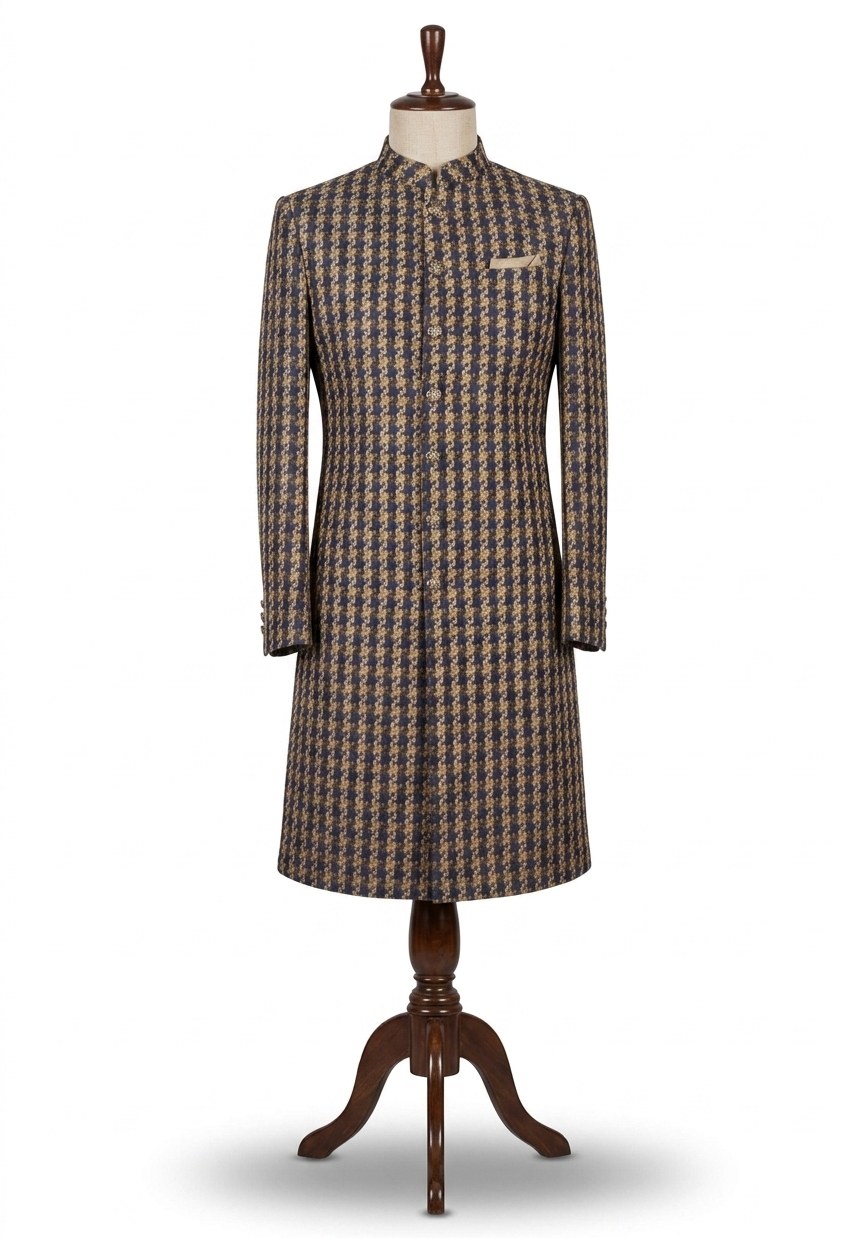
A sherwani is a long, close coat worn over a churidar, kameez or trouser, and it sits right at the top of Indian formal dress. It's what the groom wears, what the bride's father wears, what you reach for when the evening actually matters. Get the cloth right, get the fit right, keep the embroidery in proportion to the man wearing it, and nothing else in a wardrobe carries the same weight. We cut sherwanis at Sellers in silk, brocade, velvet and suiting blends, every one from your own measurements. Embroidery comes from karigars we have worked with for years and goes onto the panels before the final fitting, so what you try on is what you walk out with.
Where the sherwani comes from, and what it is now
The sherwani grew out of the achkan and the angarkha of the Mughal court, long outer coats that announced a man's standing before he said anything. What survives today is a coat falling somewhere between the knee and the ankle, close through the body, with a standing collar and a run of buttons down the front, usually in silver or gold. The line stays narrow at the chest and waist and opens out slightly towards the hem so you can walk, sit and climb into a car without fighting the garment.
Today's sherwani takes far more cloth and far more decoration than the original ever did. Brocade, woven on a Jacquard loom with raised metallic patterning, remains the most traditional and the most formal thing you can order. Plain silk with a light run of surface work suits the man who wants the shape and the occasion without the noise of full brocade. Velvet, especially in deep jewel colours, gives you a sherwani with real depth for an evening reception or a winter wedding up north.
Fit and construction, which is what you are really paying for
Everything about a sherwani rests on the fit. The shoulder has to sit clean, because on a coat this long a dropped or rotated shoulder seam is the first thing anybody notices. The chest has to close without straining at the buttons. The waist needs shaping, and how much depends entirely on your build. The length, usually between mid-thigh and the knee, gets set against your height and your proportions rather than against a size chart.
Off-the-rail sherwanis miss on all of this, and they miss differently on every body. Broad through the chest and the buttons pull. Tall and the hem finishes high and looks borrowed. Short in the torso and every proportion lands in the wrong place. Draft the pattern from your own measurements and none of those problems need solving later, because they never turn up.
A bespoke sherwani at Sellers goes through two fittings. The first is on the basted shell, unlined and loosely tacked, where we settle the fit, the balance and the length. The second is on the near-finished coat before it is pressed off. Embroidery goes onto the panels before the coat is built up, so we confirm placement at that first fitting while it can still be shifted.
Cloth for a sherwani: silk, brocade, velvet and suiting blends
Brocade is the traditional answer. Metallic zari thread, gold or silver, is woven into patterns running from quiet geometry to full floral, and the cloth does all the decorating for you, so nothing needs embroidering on top. The catch is weight. A heavy brocade sherwani turns warm and stiff, which in Chennai is not a small consideration. We lean towards lighter brocades and line them in silk or satin so the coat still moves and still breathes.
Silk in a solid colour, ivory, cream, champagne, gold, burgundy, navy or black, gives you formality without the visual weight of brocade. Zari surface work can then go exactly where you want it: panels, borders, or across the whole coat. This is the flexible route, and it lets us dial decoration up or down to match the function you are actually dressing for.
Velvet belongs to the evening and to the cold months. A deep teal or a burgundy velvet sherwani has a depth under reception lighting that brocade cannot reach. It's also considerably warmer, which makes it sensible for a December or January wedding up north or at a hill venue, and usually far too much for an afternoon muhurtham in Chennai.