
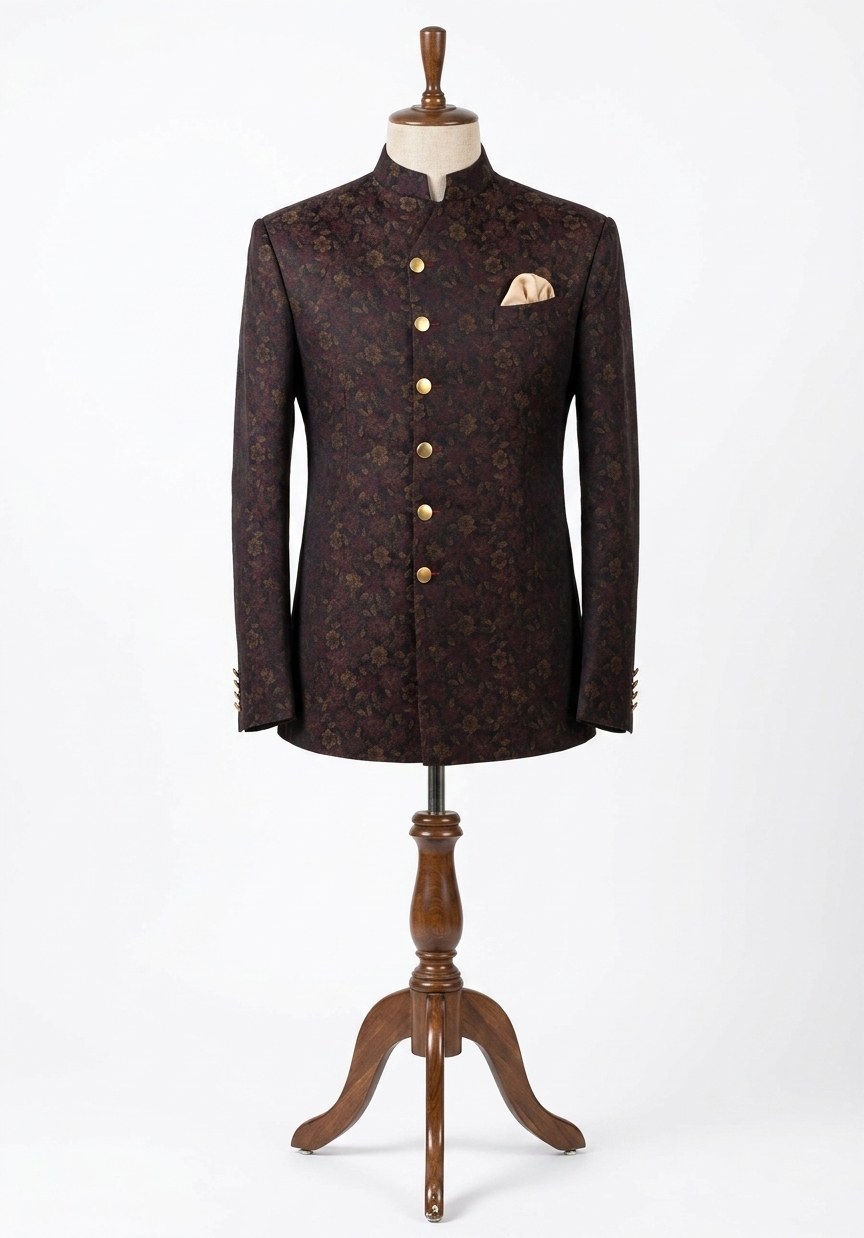
A Jodhpuri suit pairs a Western-cut jacket carrying a stand collar with matching trousers, and it's one of the few Indian-Western hybrids that actually works. It came from Jodhpur in the nineteenth century, when Indian royalty started folding British tailoring into their own dress, and the logic has held ever since: formal enough for the biggest Indian occasions, legible enough that a foreign guest reads it instantly as a suit. At Sellers we cut Jodhpuri suits in suiting wools, silk blends and the occasional brocade detail, fitted with the same care we give a two-piece business suit.
The structure of a Jodhpuri suit, and why it works
The jacket carries the outline of a Western suit jacket: the same shoulder treatment, a one or two-button front, a side or centre vent, a breast pocket if you want one. The difference sits at the neck. Instead of lapels and a notch, there's a stand collar, close to a bandhgala's, fastening at the throat. From ten metres away it reads as a suit; up close it's clearly Indian.
The trouser is cut from the same cloth, so you get a matched suit, in a straight leg that works with either dress shoes or jutti. Add a waistcoat in the same cloth, or a contrasting silk brocade one, and you've moved the whole thing up a register for a reception.
When the Jodhpuri suit is the one to order
The Jodhpuri sits in a useful gap. It's more structured and more Western than a kurta and bandi, and less ceremonially Indian than a sherwani or achkan. That makes it right for grooms who want formality without ornament, for weddings that mix Indian ceremony with a Western reception, and for professional or diplomatic occasions where you want to be dressed as an Indian without unpacking the full ethnic wardrobe.
For a groom, an off-white silk or a rich brocade Jodhpuri gives you a wedding outfit that reads as Indian formal without the cost and lead time of heavy sherwani embroidery. For a guest, a fine suiting wool in charcoal, navy or a deep jewel tone is about the most elegant thing you can wear to an Indian wedding, and you'll get more than one evening out of it.
Cloth and colour across the Jodhpuri suit range
For work and semi-formal use, take the same cloth you'd take for a business suit: a fine 120s or 130s worsted from a British or Italian mill in charcoal, navy or dark grey. Because the jacket is built like a Western one, anything that tailors well into a blazer will tailor well into a Jodhpuri.
For weddings and festive evenings the range opens right up. Fine raw silk in ivory or cream is the traditional wedding Jodhpuri. Dupion silk brings its slub texture and a bit of life to a plain colour. A subtle brocade jacket with a plain matching trouser is a good compromise for anyone who wants pattern without a full brocade suit. And rich jewel tones, deep burgundy, emerald, cobalt, in fine silk make Jodhpuris that carry a room, which is exactly what a reception asks for.