
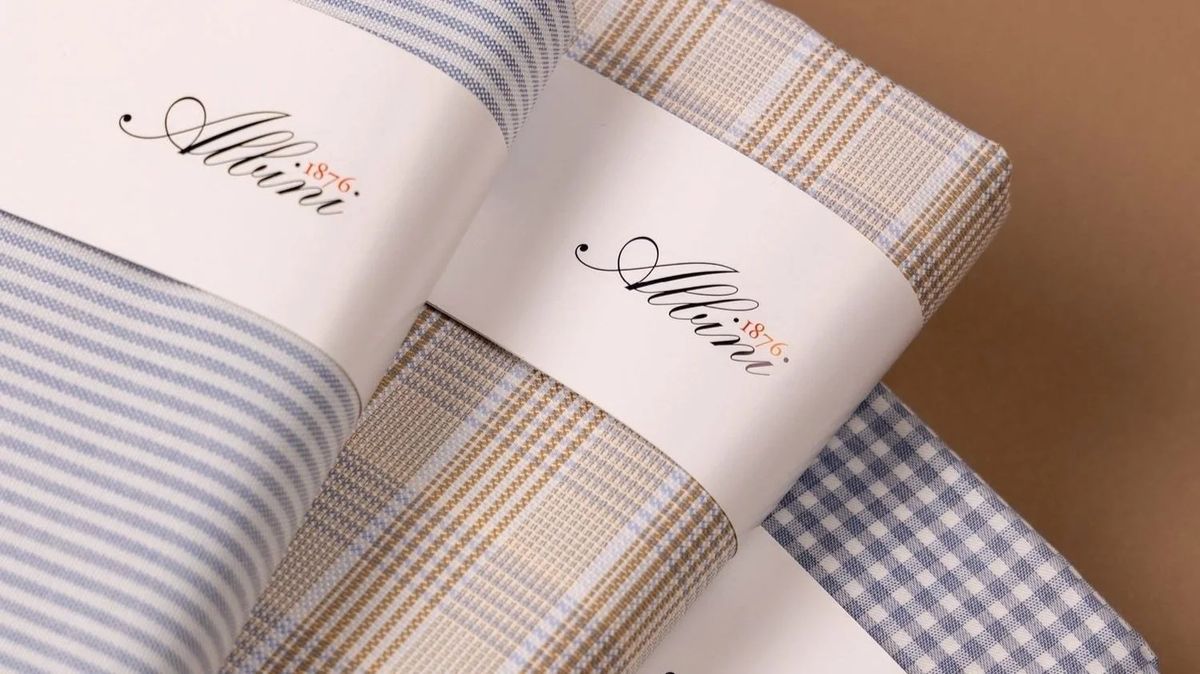
Cotonificio Albini has been weaving at Albino, in the hills above Bergamo, since 1876, and the same family still runs it five generations later. What separates them from almost every other shirting name is where the cotton starts. Albini own fields in the Nile delta and grow Giza 87 and Giza 45 themselves, which means the fibre is specified before it is even picked rather than bought on a market. For Chennai that matters more than any other cloth category we stock. Fine cotton at high thread counts is what this climate actually rewards, and Albini sit at the top of that trade. There is a second reason we like having them on the counter: the Albini Group owns Thomas Mason too, so two of our shirting bunches come out of the same house without looking or feeling remotely alike.
Founded 1876, and still the family's company
Zaffiro Borgomanero started the mill in 1876 at Desenzano sul Serio, near Bergamo in Lombardy. It has stayed under family control ever since, through two world wars, the collapse of the 1930s, and the long consolidation that swallowed most of the independent European weavers in the last fifty years. Very few names in this trade can say that and mean it.
The fifth generation runs it now. Stefano Albini is president, Andrea Albini looks after the production sites, and Fabio Albini is creative director. In 2026 the Albini 1876 brand marks a hundred and fifty years of continuous weaving.
The group today runs seven factories and employs over a thousand people. Weaving and finishing happen at Albino, Brebbia, Gandino and Albiate in Italy, with further operations in the Czech Republic, Hungary and Egypt. They put out more than 20,000 fabrics a year and supply shirtmakers, tailors and design houses in more than eighty countries.
What the Albini Group owns, and why you should care
This is the part most customers do not know, and it is worth knowing before you choose a shirt cloth. In 1992 Albini bought two historic British shirting names, Thomas Mason and David & John Anderson. In 2000 they added Albiate 1830, the Milanese house. Alongside those sits Albini Yarns, which spins for the group and for others.
Two of those names are already on our shirting shelf. The Thomas Mason bunches we open for formal whites, and the D&J Anderson cloths we bring out for dress shirts, both trace back to the same Bergamo ownership as Albini's own book. Italian technical resources went into those British mills after 1992, and the English character of the cloth stayed where it was. That is an unusual thing for a group to manage and they have managed it.
So when we lay Albini, Thomas Mason and Anderson side by side at a shirt consultation, you are not comparing three companies competing with each other. You are comparing three distinct cloth traditions kept deliberately separate under one roof. Albini's own book is the Italian one: softer in the hand, more adventurous in colour, and the most comfortable of the three in real heat.
Giza 45, Giza 87, and owning the field
Albini opened a weaving mill in Egypt, Mediterranean Textile, in 2009, followed by a yarn dyeing plant, Delta Dyeing. Having plants there led them to the step almost nobody else takes, which is cultivating the cotton directly. They now grow Giza 87 and Giza 45 on their own fields along the Nile delta.
Giza 45 is the reason this matters. It is grown on a small area in the eastern part of the delta, picked by hand, and the annual crop averages around ninety bales. Ninety. That is the entire world supply of the finest shirting cotton there is, and Albini control a share of it at the source rather than bidding for it afterwards.
What you feel in a finished shirt is fibre length and fibre uniformity. Longer, more even staple spins into a finer yarn with fewer joins and a smoother surface, so the cloth stays smooth through years of washing instead of going fuzzy in the first season. In Chennai, where shirts get washed hard and often, that is the whole argument for buying good cotton once instead of ordinary cotton three times.
Albini in a Chennai wardrobe
We will say this plainly. Fine shirting is the most sensible imported cloth category for anyone living here. Heavy suiting fights the weather. A high-count Italian poplin works with it. Albini's lighter constructions, the fine poplins and voiles, are about as comfortable as a formal shirt gets in April, and they still take a press for a Monday morning.
For everyday office shirting we usually start you on Albini's standard poplin and fine twill in white, pale blue and the quieter stripes. For a shirt that has to be the best thing you own, the top of their book in Giza cotton is the finest shirting we can put in your hands, and we will tell you honestly when a commission does not need it.
Albini colour is worth mentioning on its own. The Italian book runs wider and warmer than the English houses, which is useful in a city where a lot of men wear a shirt without a jacket for most of the year. If the shirt is doing the work on its own, it may as well be interesting.
Come in and handle an Albini poplin next to a Thomas Mason Gold. Same group, completely different cloth. You will pick one within a minute of touching both.