
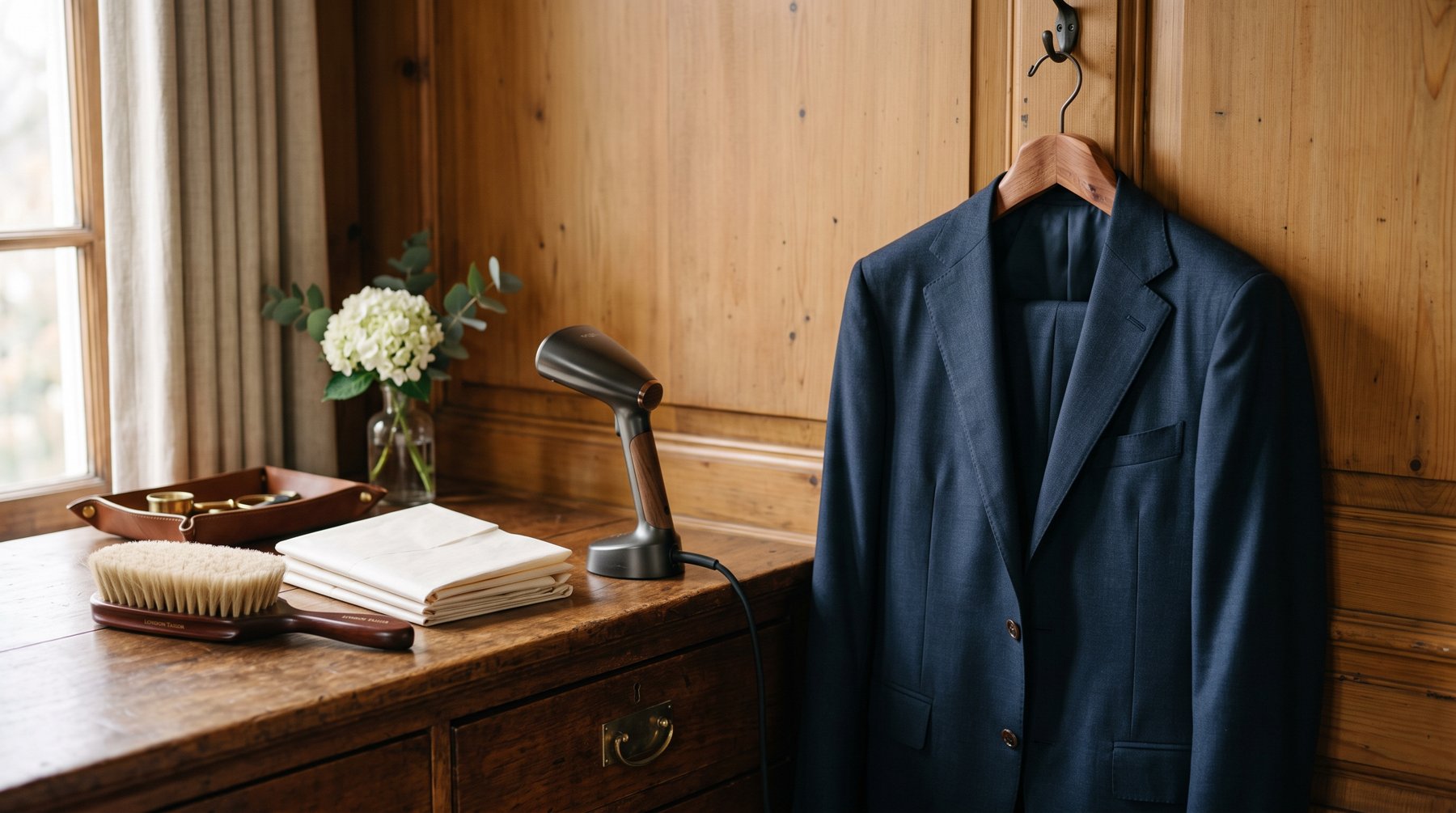
A suit in decent wool, looked after, will look better at ten years than a cheap one looks at ten months. That's just how wool behaves — the fibre is springy, resists odour, and sheds creases if you give it the chance. Treat it badly, though, and it goes off faster than it should. Dry clean it every month, hang it on wire, never brush it, and you'll shorten its life by years. None of what follows is difficult. It applies just as much to a shirt off our rails as to something we cut for you.
After you wear it — thirty seconds
Three things. Hang it on a shaped wooden hanger, never wire, which will slowly wreck the shoulder. Brush it down with a soft clothes brush, which lifts dust and city grime off before it works into the weave. Then leave it alone for at least a day before you wear it again.
That rest day matters more than people expect. Wool recovers from a day's compression, but only if you give it the time. A suit worn every day ages in months what a suit worn twice a week takes years to reach. If you wear suits daily, you need at least two in rotation. This is the single cheapest thing you can do for your wardrobe.
The clothes brush is the most ignored tool in the cupboard. Use it regularly and you'll dry clean far less often, which matters, because dry cleaning is the fastest way to wear out good wool.
Dry cleaning — as little as you can get away with
Dry cleaning is a solvent process. It strips the natural oil out of wool, and done too often it breaks the fibre down and shortens the cloth's life. For a suit in regular use, once or twice a season is plenty.
Between cleans, use the brush and the rest day. If something needs freshening, hang it overnight somewhere with air moving, or in the bathroom while a hot shower runs. The steam relaxes the fibres and takes surface smell out without any chemicals near it.
For a mark, act fast. Clean white cloth, cold water, work from the outside of the mark inwards so you don't spread it. Blot, don't scrub. If it won't shift, bring the garment in and we'll tell you what will work on that cloth. Attacking a fine worsted with household cleaner does damage that is very hard to undo.
When you do clean it, use someone who knows tailored clothes rather than the cheapest shop on the road. The press afterwards is half the job, and an automated press flattens a hand-padded lapel roll that took hours to build.
Storing it, especially in Chennai
Hangers. Shaped, wooden, the width of your shoulder. Cedar is best — it holds moisture off and moths dislike it. Wire hangers deform the shoulder within months. Throw them out.
Bags. Cloth, not plastic, for anything in regular use. Cloth breathes; plastic traps damp, and Chennai humidity turns trapped damp into mildew faster than you'd think. For things stored long term — a sherwani, a suit for one specific occasion — use a closed cloth bag with a cedar block or a neem ball inside.
Hang or fold. Jackets always hang. A jacket is built in three dimensions and folding collapses them into creases that don't come out. Trousers can hang from the waistband on a trouser bar, or folded over a bar along their own crease — along it, never across.
Moths and silverfish. Less of a menace here than in cold climates, but not absent, and humidity brings its own problems. Cedar, neem and lavender all help. Naphthalene works and leaves a smell that never fully comes out of fine cloth. Regular brushing and airing does more than any of them. If you spot damage, bring it in straight away — small holes can be rewoven, large ones can't.
Pressing at home
You can press at home, and for travel creases it's usually enough. One rule above all: never put an iron directly on the cloth. A dry iron on fine worsted leaves a permanent shine, because you've flattened the fibres instead of reviving them. Always a pressing cloth in between, slightly damp, and let the steam do the work.
Better still, hold a steam iron two or three centimetres off the surface and let the steam alone do it. That's the right approach for the front of a jacket and the lapels, where pressing hard will flatten the roll and the shape of the chest.
Never press lapels flat. They're padded to roll, and once you've crushed that you can't put it back. Press around them. If the roll has been squashed in a suitcase, hang the jacket in a steamy bathroom for twenty minutes and it comes back on its own.
For something important, get it pressed properly. We press garments here when people bring them in, and with a bit of notice we can usually do a same-day press before an occasion — including on things you didn't buy from us.
Shirts
Fine cotton shirts wash well if you're gentle with them. A cool machine cycle at 30°C is fine for most; hand wash the very fine cloths and anything with embellishment or French cuffs. Skip the tumble dryer — it's hard on cotton. Air dry, ideally in shade.
Iron a shirt while it's still slightly damp; the cotton gives much more easily. Order matters: collar first, spread flat and pressed outwards from the centre, then cuffs, then sleeves, then the body. Do the collar properly and decisively. A soft, half-pressed collar undoes everything else you did.
Good shirts have mother-of-pearl or quality resin buttons, which are more fragile than cheap plastic. If your machine spins hard and you can't control it, pull the shirt out before the spin — high-speed spinning chips buttons.
Sherwanis, kurtas and silk
Anything embroidered or embellished goes to a dry cleaner, full stop. Home washing distorts the structure and can pull the work loose. A plain silk kurta can be hand washed in cold water with a mild detergent — don't wring it, press the water out in a towel and dry it flat in shade.
Velvet is dry clean only, always. The pile runs in a direction and pressing it the wrong way flattens it permanently. Store velvet hanging, in a cloth bag, with nothing pushed up against the surface. Never iron it. If it needs steam, hang it and steam from a distance so the pile can lift.
Heavily embroidered sherwanis and bandhgalas are best stored inside out so the work isn't rubbing against anything, with tissue paper between embroidered panels. Zardozi in particular will snag on whatever is hanging next to it.
Bring it back to us
Anything we made, we mend. A lining gone, a button off, a seam opened, a moth hole that needs reweaving — bring it in. Small repairs are usually free or close to it, and we know exactly what cloth and construction went into it. Plenty of what we fix we didn't make in the first place; that's fine too.
Please don't attempt it yourself with iron-on patches or fabric glue. They show, and glue bonds into the cloth in ways that make a proper repair much harder afterwards. It's a five-minute job for us and rarely worth the risk at home.