
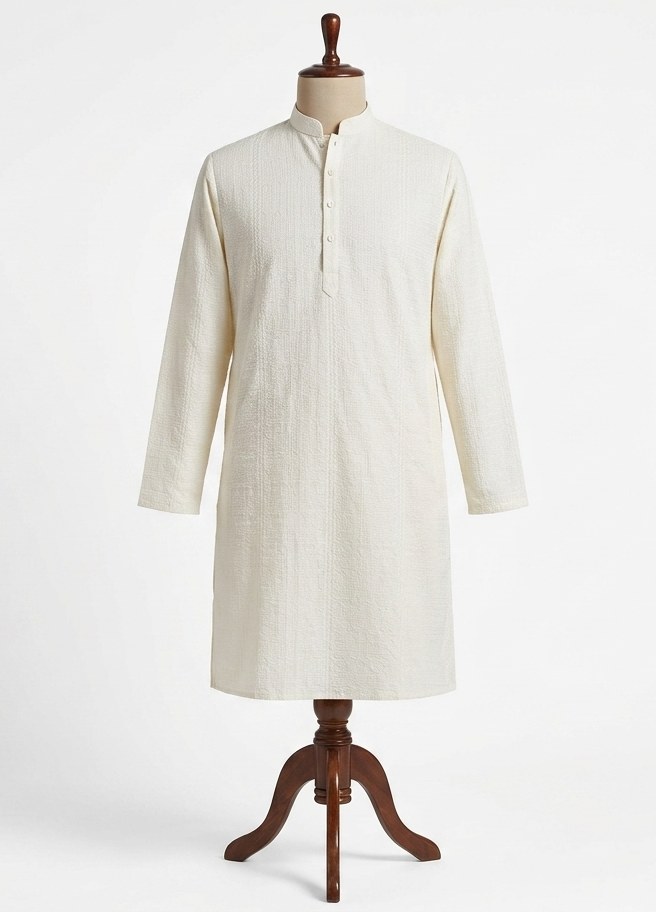
Kerala carries three distinct wedding traditions: Hindu, with Nair and Namboothiri variants; Christian, across Syrian Christian, Latin and other communities; and Muslim, in the Moplah tradition of the Malabar coast. Each dresses differently, but they share a palette. White, cream and the warm off-white of kasavu run through all three. The kasavu mundu, a white cotton or silk dhoti with a gold zari border, is the most Keralite garment there's, and it turns up in some form at every one of these weddings.
Kerala Hindu weddings: the mundu and the shirt above it
The groom wears a fine kasavu mundu in double-cloth silk, a heavier and more formal version of the everyday mundu, with a matching upper cloth. What goes above it changes by community: a fine white jubba, a formal white cotton or silk shirt, or a Nehru-collar kurta in white or cream. Very few pieces and very little decoration, which means the cloth and the fit are carrying the entire outfit between them.
We make the jubba, kurta and shirt half of that. The mundu itself usually comes from the family's own weavers in Kerala, as it should. The upper garment is where a bespoke cut earns its keep: shoulders that sit flat, a chest that doesn't balloon over the mundu, sleeves that end where they ought to. Ready-made rarely manages all three at once on the same body.
If the reception calls for something with more presence than the mundu, our guide to the wedding sherwani in Chennai covers cloth for the weather, embroidery, and how early to start.
Kerala Syrian Christian and Moplah Muslim weddings
Kerala Syrian Christian weddings, particularly in the Jacobite and Orthodox communities, usually put the groom in a good suit: white or cream for the morning service, navy or charcoal for the reception. The Western suit has been part of Syrian Christian life since the colonial period and carries no sense of borrowing at all. A well-made ivory suit at one of these weddings is about as contextually correct as a garment gets.
Kerala Moplah Muslim weddings share the white-first palette of Tamil Muslim celebrations. The nikah asks for a fine white kurta with churidar or a mundu; the reception opens up considerably. The Moplah tradition has its own details as well, including a particular cut of white kurta with restrained embroidery at the collar, which sets it apart from North Indian Muslim wedding dress.