
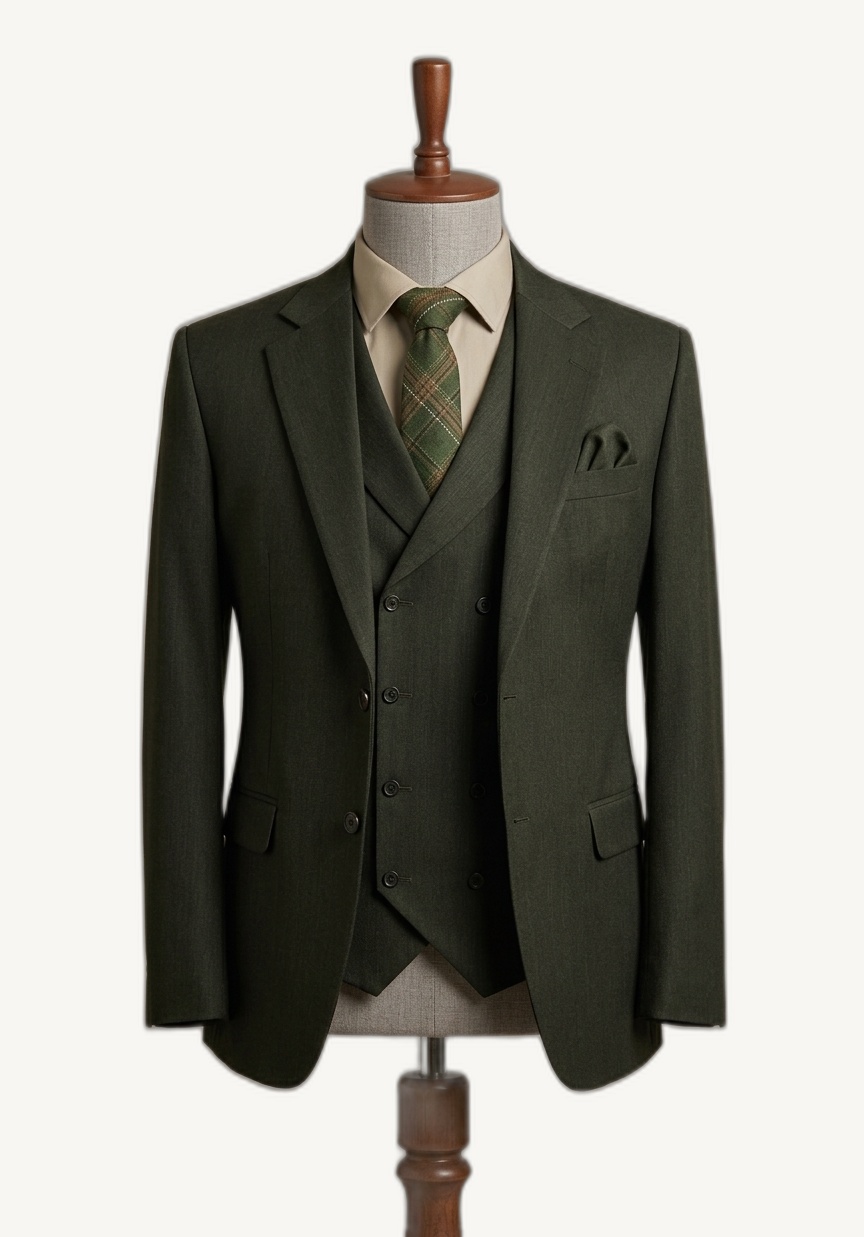
A two-piece suit is a jacket and a pair of trousers, no waistcoat, and it does more work than anything else you own. It is also the suit most people buy in a rush and regret later, usually because the cloth was wrong for Chennai, the shoulders never sat right, or nobody bothered to alter it afterwards. We go about it the other way round. We measure you, draft a pattern that belongs to you alone, let you choose the cloth yourself, and fit the suit at least twice before it leaves the shop. Prefer our ready-made floor? The same tailors alter it, usually inside the week.
What a two-piece suit has to get right
A two-piece suit is a jacket and trouser cut from one cloth. Easy to describe, hard to do. The jacket has to sit across your shoulders, chest and back without dragging or collapsing. The lapel should roll, not crease. The front closes without straining. The sleeve ends where it lets about half an inch of shirt cuff show. The back hangs clean, with no ripple under the collar and no pooling over the seat. None of that is luck. It comes from a pattern drawn for your body, a cutter who knows what he is looking at, and a fitting on the basted shell before anything is finished off.
The trouser has just as much to answer for. Where it sits on the waist, how far it travels from waistband to seat, how it falls through the thigh and knee, and where it breaks on the shoe. The front crease should drop in a straight line. There should be enough room in the seat to sit through a two-hour meeting without the cloth pulling across it. You do not get that from a standard block nipped in here and let out there. You get it from a trouser cut to your waist, your hip and your leg.
Get both right and you have the most useful garment in the wardrobe. A board presentation, a wedding you have been invited to, an interview, a funeral, a client meeting where you want to look like you took it seriously. One suit covers all of it. Buy it well once and you stop thinking about it.
Picking the cloth for a Chennai wardrobe
The cloth decides how the suit behaves. A Super 120s navy worsted from Vitale Barberis Canonico hangs nothing like a lightweight fresco from Holland & Sherry, and neither of them behaves like a flannel or a linen. Where you will wear it, and in what weather, matters more than the label.
For most of our year, the sensible answer is a lightweight tropical worsted or a fresco. High-twist wool breathes, shrugs off creases and still looks pressed after a full day in a warm room and a warmer car. Look at roughly 200 to 240 gsm. Our Holland & Sherry Fresco range and the tropical weights from Vitale Barberis Canonico are built exactly for this kind of climate.
For the short cool spell from November to February, a medium worsted at 260 to 300 gsm, or a flannel, comes into its own. Flannel drapes beautifully and feels like something. It is miserable in May, so be honest with yourself about how often you will reach for it.
For the occasions that matter, a finer wool at Super 120s or above gives a quiet sheen and a closer drape. It photographs well and reads as considered from the far end of a room.
On colour, start with charcoal, mid-grey or navy. They take the widest range of shirts and ties, suit the widest range of rooms, and they age quietly. A charcoal suit will not look dated in six years the way a fashionable colour will. Once that one is in the wardrobe, the second and third can have more character: a chalk stripe in mid-grey, a glen plaid in charcoal and cream, a warm tan linen for daytime functions.
How we build it, and why the canvas matters
Every two-piece suit we make is canvassed. We do not treat that as an upgrade, it is simply how a jacket ought to be built. The canvas is a layer of woven horsehair and cotton that sits between the outer cloth and the lining. It gives the jacket its shape and its drape, and over the years it learns the shape of you.
Half-canvas is our standard: the canvas runs through the chest and lapel down to the button stance. For a suit you expect to wear to the big occasions for the next decade, we build it full-canvas, with the interlining carrying on to the hem and through the sides. A full-canvas jacket softens with wear. The chest starts to follow your chest, and the lapel settles into a roll that stays put. There is very little in menswear that beats it.
Lapels are hand-padded, which means rows of small stitches locking the canvas to the cloth and setting the curve of the roll. The collar is stitched down by hand. On a full bespoke commission the buttonholes are worked by hand as well, which gives a cleaner and stronger loop than any machine manages. Buttons go on with a linen thread shank so they stand off the cloth and the jacket closes without pulling.
The lining is cut and made up separately, then put in by hand at collar and hem, with a small box pleat down the centre back so it can move when you do. Whether that lining is a quiet tonal silk or something with a bit of a pattern to it is your call, and we settle it at the consultation.
The decisions a ready-made suit makes for you
Buy off the rail and someone else has already chosen the lapel, the pockets and the vents. Here you choose them. A quick tour, so you can turn up to the consultation with a view.
Lapel style. The notch lapel, with a V cut where the lapel meets the collar, is the standard business lapel. It works everywhere and never shouts. The peak lapel points upward above the notch, and it is bolder and dressier. It came from double-breasted suits and black tie, but plenty of men now want it on a single-breasted suit for the character. The shawl lapel belongs on evening wear and nowhere else.
Pockets. Jetted pockets, a slit with a narrow welt and no flap, are the dressiest. Flap pockets are the workhorse. You can tuck the flaps in when you want a cleaner line and leave them out the rest of the time. Patch pockets, sewn onto the outside of the jacket, are the most relaxed of the three. Right on a sports jacket, out of place on a business suit.
Vents. A single centre vent is practical and common. Two side vents, one over each hip, are dressier and behave better when you sit down or put a hand in a pocket. No vent at all is the old English formal answer and still suits a waistcoated three-piece. We will tell you which one flatters your build.
Buttons. Two is the standard. Three reads more traditional, with the top button usually left open. One button is formal and belongs with evening dress. Where that button sits on your chest, the button stance, is fixed at the pattern stage and it quietly sets the whole shape of the jacket.
Trouser details. Flat front, or one or two forward pleats. Side adjusters or a full waistband. Turn-ups or none. And the break, meaning how much cloth rests on your shoe, anywhere from a clean no-break to a full traditional one. We talk all of it through and set it at the fitting.
What a good fit actually feels like
A suit that fits looks like you have not thought about it. It does not pull across the chest when buttoned. It does not bunch at the collar or ripple down the back. The jacket hangs straight from a shoulder that finishes at the end of your shoulder bone, with nothing overhanging and nothing digging in. The sleeve hangs without twisting. There is shape through the chest, but not so much that it strains the moment you sit.
The shoulder matters most, because it is the one thing nobody can fix after the jacket is made. If the shoulder is wrong, the jacket is wrong, and no amount of taking in at the waist will rescue it. That is why we spend so long on shoulder placement and sleeve pitch at the middle fitting. It is the part of bespoke you are really paying for.
You judge a trouser by how little you notice it. It sits on the waist without pinching or gaping, moves through the seat without grabbing, and falls from the knee with enough fullness to hang but not so much that it flaps. The break at the shoe is whatever you asked for, done cleanly.
A well-cut suit is comfortable where an expensive badly-cut one never is. You can sit, bend, reach up for a bag in an overhead locker, and the jacket stays where it is instead of riding up your back. The trouser goes with you instead of fighting you. That is not luxury. That is clothing doing its job.
How long it takes
A bespoke two-piece suit at Sellers runs four to six weeks from the first appointment to collection. Consultation and cloth, pattern drafting, cutting and making, a middle fitting, finishing, then the final fitting. If you are working to a date, a wedding, a board meeting, a court appearance, say so at the start and we will tell you straight away whether it is doable. If it is not, we will say so rather than promise and disappoint you.
The consultation takes sixty to ninety minutes, sometimes longer if it is your first suit with us and you want to go through the cloth at leisure. We measure you, note the pattern and settle every style detail. You should leave knowing exactly what you have ordered.
The middle fitting falls at around week four, with the suit assembled in your cloth but not yet finished. Twenty to thirty minutes. We mark the changes and it goes back to the workshop. Collection and the final fitting take fifteen to twenty minutes, less if the middle fitting did its job.
Looking after it
Treated well, a bespoke two-piece will still be in service twenty years from now, and looking after it costs almost nothing. Brush it down with a soft clothes brush after each wear to lift the dust. Hang it on a shaped wooden hanger, never wire. Give it a day off between wears. Dry clean as little as you can get away with, twice a year is plenty for most people, and stay away from the cheap place that will press the life out of good cloth.
Steam does most of the work. A professional press, or simply hanging the suit in the bathroom while you shower, brings the fibres back after travel or a long day at a desk. If you press it yourself, always put a damp cloth between the iron and the suit. Never let a hot iron touch the cloth directly.
When something goes, a button, a hem seam, a lining torn at the collar, bring it in. Most of it is ten minutes of work. On a suit we made, small repairs cost you nothing.