
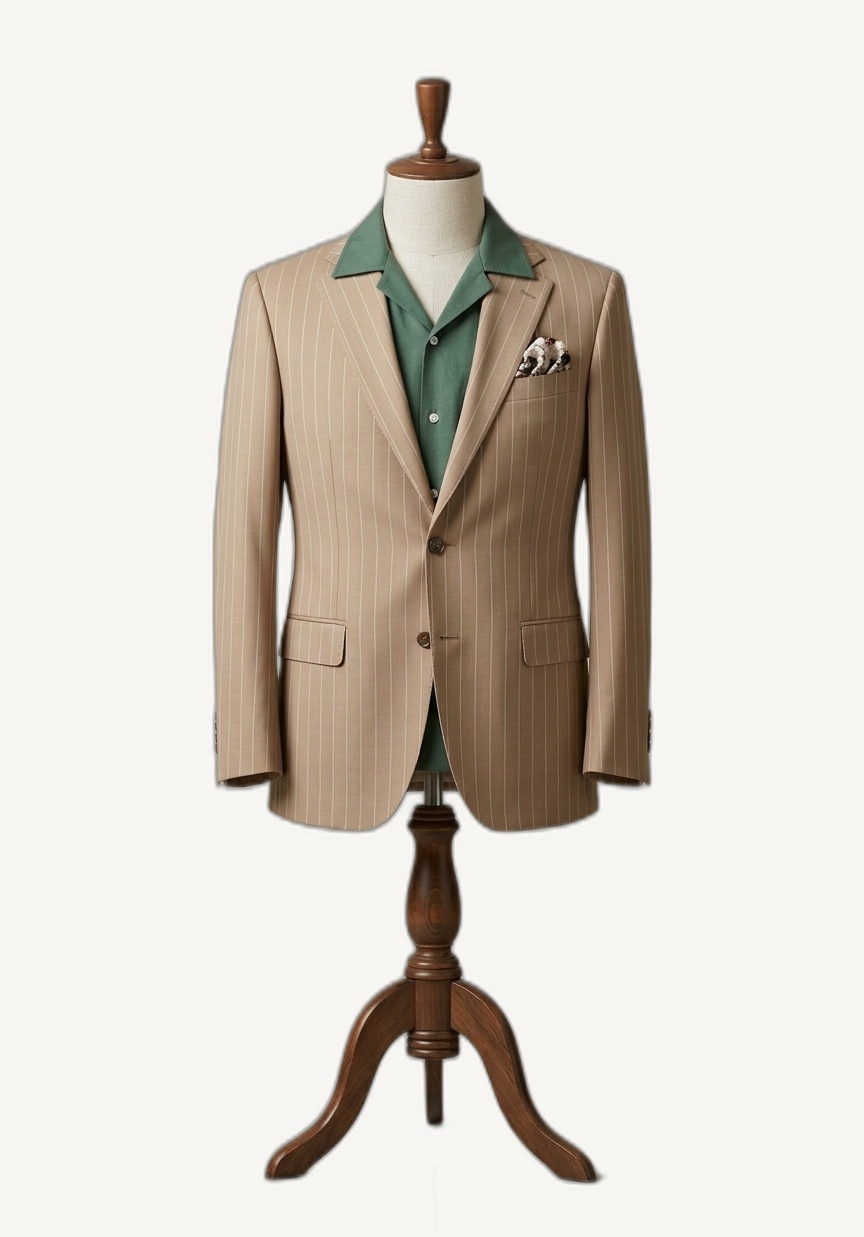
No other suit carries as much history as a pinstripe. It belongs to the City of London, to Savile Row in its confident years, to the senior advocate in the High Court and the managing director of the firm that has been going since his grandfather ran it. Get the proportions, the cloth and the fit right and it tells a room you have been doing this a long time, in a way no plain suit can. We cut pinstripe suits from heritage stripe cloths by Holland & Sherry and Scabal, in the chalk and pencil stripe traditions that have set the tone for formal dress for generations.
Chalk, pencil or pin, and how they differ
Three stripes turn up in suiting, and each one behaves differently on the body.
The chalk stripe is the boldest of them. A wider stripe with slightly soft edges, as though it had been drawn on with chalk, usually cream or ivory against a dark navy or charcoal ground. Historically it is the dressiest of the three, tied to British banking and legal dress in the early twentieth century, and it still carries more weight than either of the others. In flannel it is soft and old-school. In worsted it looks sharper and more current.
The pencil stripe is narrower and cleaner, a fine sharp line repeating at regular intervals. It gives up a little formality against the chalk stripe and gains a little range in exchange. It works equally well on navy and on charcoal.
The pin stripe is the finest of the three, a very thin line set close, sometimes so fine it is really a row of dots. From across a room it just looks like texture, and you only see the stripe up close. If you have never worn a striped suit before, start here. A navy or charcoal pinstripe is the easiest one to live with by a distance.