
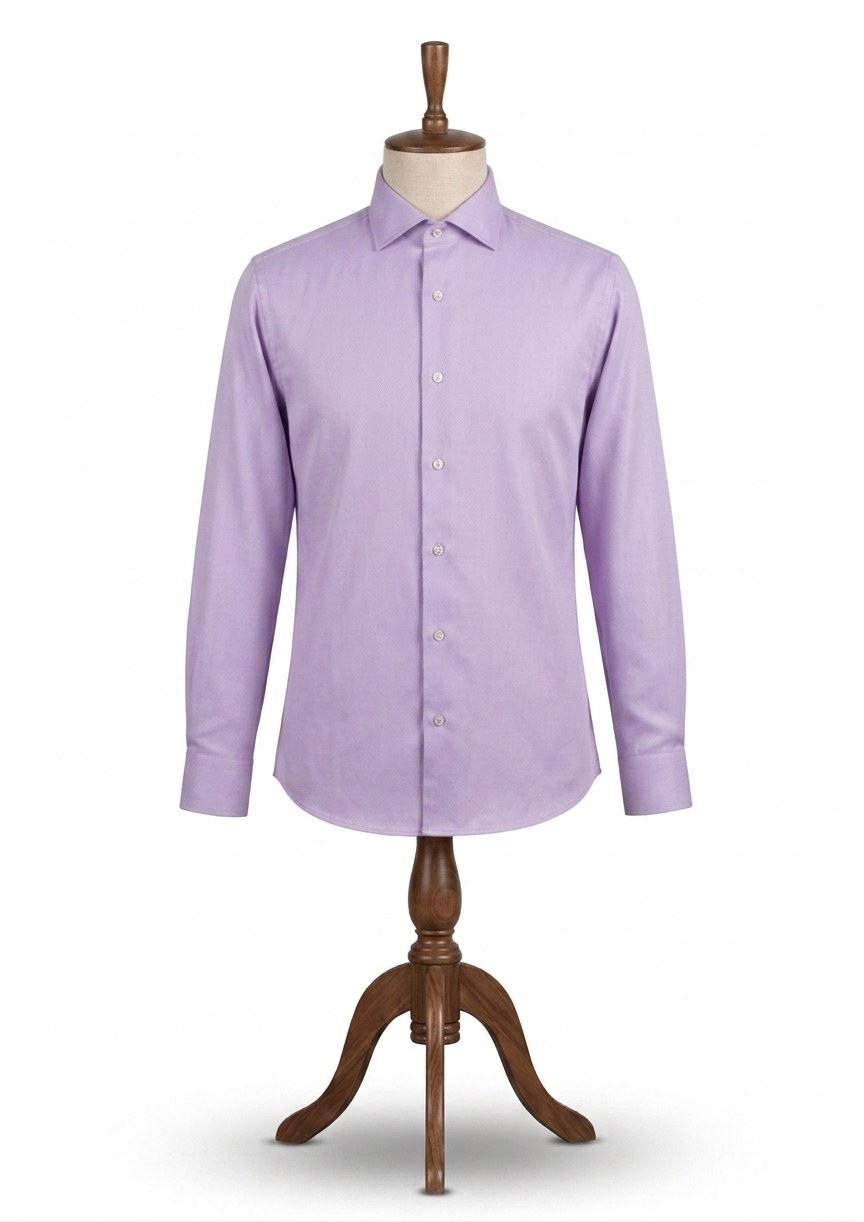
In a twill weave the weft passes over two or more warp threads, which is what produces the diagonal rib you can see running across the cloth. It is the same weave that gives you heavy woollen twill in a suit, but taken down into fine cotton at 80s to 120s it makes a shirting that is softer in the hand than poplin, falls with more drape, and catches the light differently thanks to that diagonal surface. If you have always found poplin a bit stiff or a bit sharp, this is the cloth to try. It feels comfortable from the first wearing rather than after the fourth wash.
How it differs from poplin in practice
Poplin is crisp, smooth and precise. Twill is soft, draped and textured. Both are perfectly proper business cloths and neither is dressier than the other. A fine 100/2 twill shirt is every bit as formal as a poplin of the same quality. The difference is in how it feels and how it catches the eye, not in where you can wear it.
Twill also takes colour differently. That diagonal rib makes the light fall unevenly across the surface, so the colour appears to shift slightly as you move, which gives the cloth a depth that flat poplin does not have. It makes twill a very good choice for richer colours. A deep mid-blue twill is far more interesting to look at than a mid-blue poplin in exactly the same shade, purely because the surface is doing something.
On the wearing side, twill feels softer from the start. There is none of that board-like stiffness a freshly laundered poplin has for the first hour. It also hides creases better, because the diagonal texture breaks them up where a smooth surface puts them on display. For anyone who spends the day in and out of meetings, cars and airports, twill is usually the more practical shirt, and it is what we suggest to customers who travel a lot.
Where twill really pays off
Twill is fine in white and pale blue, the two shirts everybody needs, but it comes into its own in mid-tones and richer colours where the surface depth gives you something extra. A mid-blue, a warm pink, a deep burgundy. All of them look better in twill than in poplin because the weave adds a dimension the flat cloth cannot.
Stripes behave differently here too. The twill weave softens the edge of a stripe slightly, so the pattern looks a touch less sharp than the same stripe in poplin. That can read as warmer and more relaxed, which is exactly right in some offices and slightly too soft in others. Tell us where you work and we will point you at the right one.
The part that goes wrong in cheap twill shirts
Twill has to be cut carefully, because the diagonal in the weave creates a bias. Ignore it in the cutting and the shirt will slowly twist on the body as you wear it. One shoulder ends up sitting higher than the other, or the whole body rotates round your torso by the afternoon. It is one of the commonest faults in mass-produced twill shirts and almost nobody can name what is wrong, only that the shirt feels off.
We cut twill allowing for that bias, and we cut the collar on a specific grain so it sits square at the neck instead of pulling to one side. The shirt then hangs straight from the shoulder, buttons up without twisting, and gets through a full day without you tugging at it every hour. That is not a glamorous detail, but it is the reason a made-to-measure twill shirt behaves and a rail one does not.