
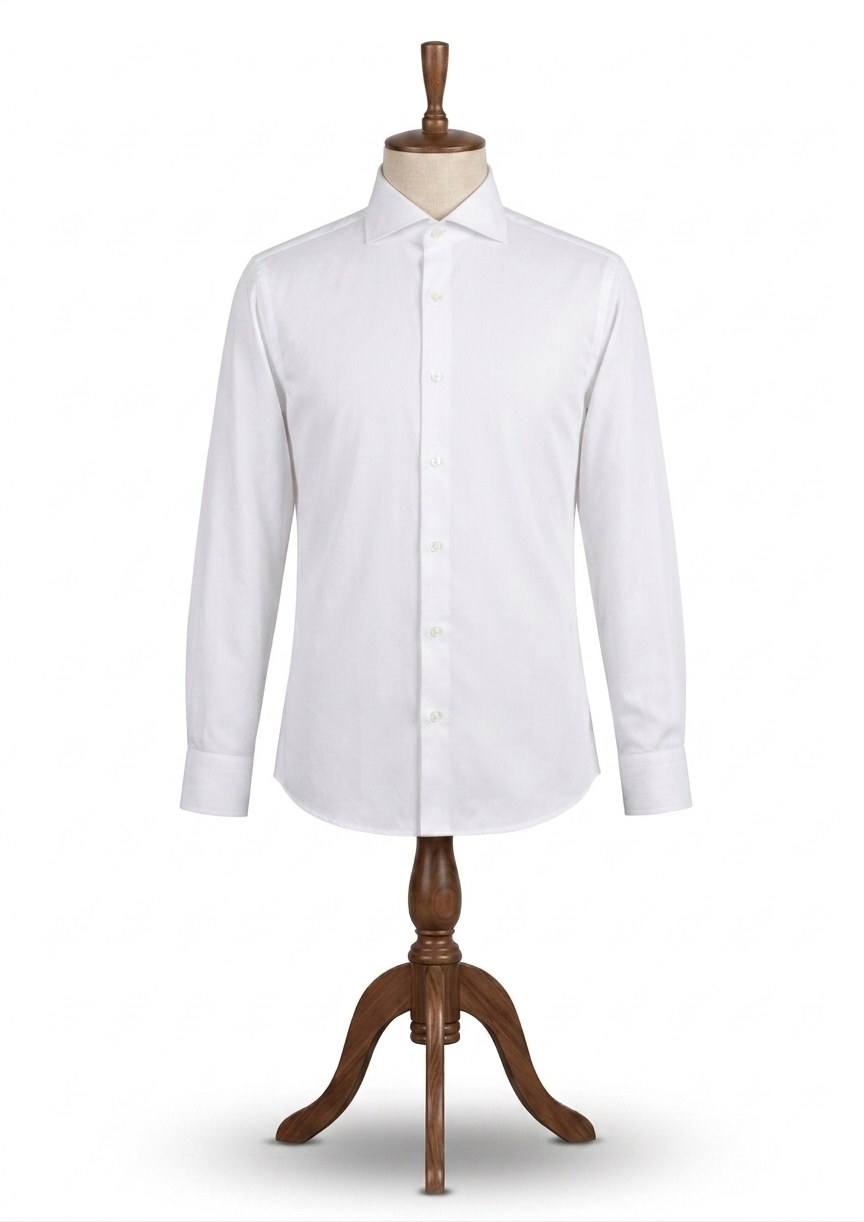
The spread collar has more or less taken over professional dress worldwide, pushing aside the point collar that ran the twentieth century. There is a sensible reason for that. The wider gap between the points makes room for the fuller tie knots people actually tie now, and the same collar still looks right when the tie comes off at the end of the day. When we make one here, the spread is set for your face and your neck rather than to whatever angle a factory decided on, which is the difference between a collar that suits you and a collar that merely fits.
Three things we can change, and why they matter
A spread collar has three variables: the angle between the points, the height of the band that lifts the collar off your neck, and the length of the points themselves. Change any one of them and the collar looks different on you.
The angle is the big decision. A moderate spread, with the points about four to five inches apart, is the most useful. It handles a half-Windsor or a Pratt comfortably and sits right with the top button open. Push it wider, five to seven inches, and you get a bolder, more open look that suits a full Windsor and reads as more current. Wider still and you are into cutaway territory. Come in and we will put the collar examples in front of you and work out which angle suits your neck width, the knot you actually tie, and how formal you need the shirt to be.
Band height decides how much collar shows above your jacket lapel. A taller band, around 3.5 to 4 cm, looks more formal and more precise. A lower band sits closer to the neck and feels easier. Neither is wrong. It is preference, and a bit of context.
It works with a tie and it works without one
With a tie, the spread collar does its job because the opening is wide enough to frame a knot cleanly. A half-Windsor or a Pratt, which are the two knots most men should be tying most days, sit right in the middle of the opening where you can actually see them. A full Windsor, with its triangle, looks especially good in a wider spread where it fills the space instead of being squeezed into it.
Without a tie it works because the points lie flat instead of rolling and curling upwards, which is what a point collar tends to do the moment you take the tie off. A spread collar worn open under a jacket is about the easiest smart-casual look going. The points sit down on the lapels, the shirt front stays neat, and the whole thing reads as deliberate rather than as a man who simply forgot his tie.
What to make it in
Any shirting will take a spread collar, but the natural partner is a firm smooth poplin or twill, cloth that holds the collar shape and gives you a crisp edge. A Thomas Mason 100/2 two-ply poplin has exactly the right handle. Smooth enough to iron flat, firm enough to still be flat at six in the evening.
Given how warm most of our working days are, a two-ply poplin around 80 to 90 gsm gets the balance right between crispness and being able to breathe. Heavier cloths are lovely if you spend the day in air conditioning, but they turn against you the moment you are standing outside waiting for a car.
On colour, white and pale blue are the obvious picks for a working spread collar shirt. The collar is already doing the talking. Keep the cloth clean and contained and let it, rather than piling a loud pattern underneath a bold collar and having the two argue.