
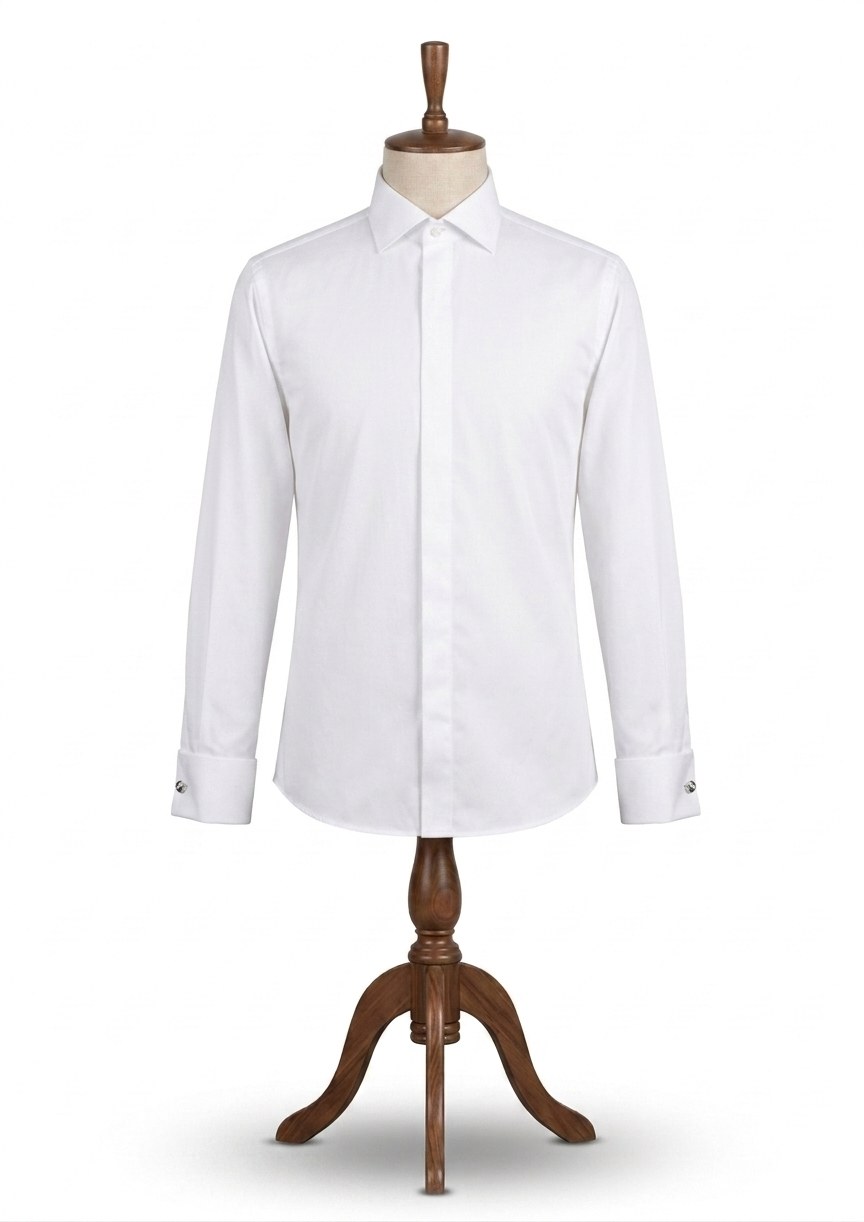
Strictly it is a double cuff, because the cuff folds back on itself and fastens with links instead of buttons, but everyone calls it a French cuff and we are not going to argue. What it does is add a formality to a suit that nothing else quite delivers. The link, showing between your jacket cuff and your shirt cuff when you reach across a table, is very nearly the only piece of jewellery a man wears at work. Which is why the shirt has to be right: a crisp fold, clean and evenly worked holes, and a sleeve length exact enough that the right amount of cuff shows. A centimetre out either way and the whole effect falls over.
What goes into a double cuff
A double cuff is twice as deep as a plain barrel cuff. Unfolded it runs a long way down the arm, then folds back on itself at the midpoint to give you two layers of cloth at the wrist. Four buttonholes hold it, two pairs sitting either side of the fold, and the link goes through all four at once.
How well that cuff is made is the whole thing. The buttonholes have to be worked cleanly, evenly and in exact alignment, because any slant in a hole or wobble in the eyelet shows the moment a link goes through it. And the fold has to sit at the right depth. Too shallow and the cuff looks mean. Too deep and it becomes a nuisance every time you put a jacket on. We hand-finish our double cuffs and pay particular attention to the buttonhole work, which we think is one of the small details that separates a proper shirt from an expensive one.
When to wear them and when not to
A double cuff lifts the formality of whatever shirt it is on. A white poplin with double cuffs is a dressier shirt than the same cloth with a barrel cuff, full stop. That makes it the right answer for the serious end of things: board presentations, senior meetings, black-tie evenings where a proper dress shirt is required, and weddings where you are one of the principals rather than a guest at the back.
They also suit anybody who simply wants to dress with a little more precision than a standard business shirt allows. A pale blue or white Thomas Mason poplin with double cuffs, under a fine worsted suit with a tie, is about as polished as professional dressing gets. It reads as serious without being stiff, and as careful without showing off.
Where they do not belong is anything casual. A double cuff under a relaxed blazer or a tweed sports jacket looks overdressed, and there is no way of styling around it. In those situations a barrel cuff, still well fitted and still in good cloth, is the right call, and we will tell you so rather than sell you the fancier option.
Choosing links
The point of a double cuff is that the links are on show, so what you put in matters. Keep it simple. A plain oval or round face in silver or gold, a plain enamel, a knot link. Novelty links and anything with a theme are best kept out of formal rooms. A link should be noticed, but it should not become the thing people talk to you about for the first five minutes.
Match the link to the occasion. Silver or white gold reads more formal than yellow gold. A plain face reads more formal than a patterned or enamelled one. For a dinner suit, a white dress shirt with plain sterling silver or gold links is correct and needs nothing else. For a business meeting, something with a bit of colour or personality is fine and gives you somewhere to put a little character.
We keep a selection of links in silver and gold-plated finishes here, so you can buy them at the same time as the shirt and try them against the actual cloth. Ask us which ones work with which colours. We have watched a lot of combinations walk out of this shop and we have opinions.