
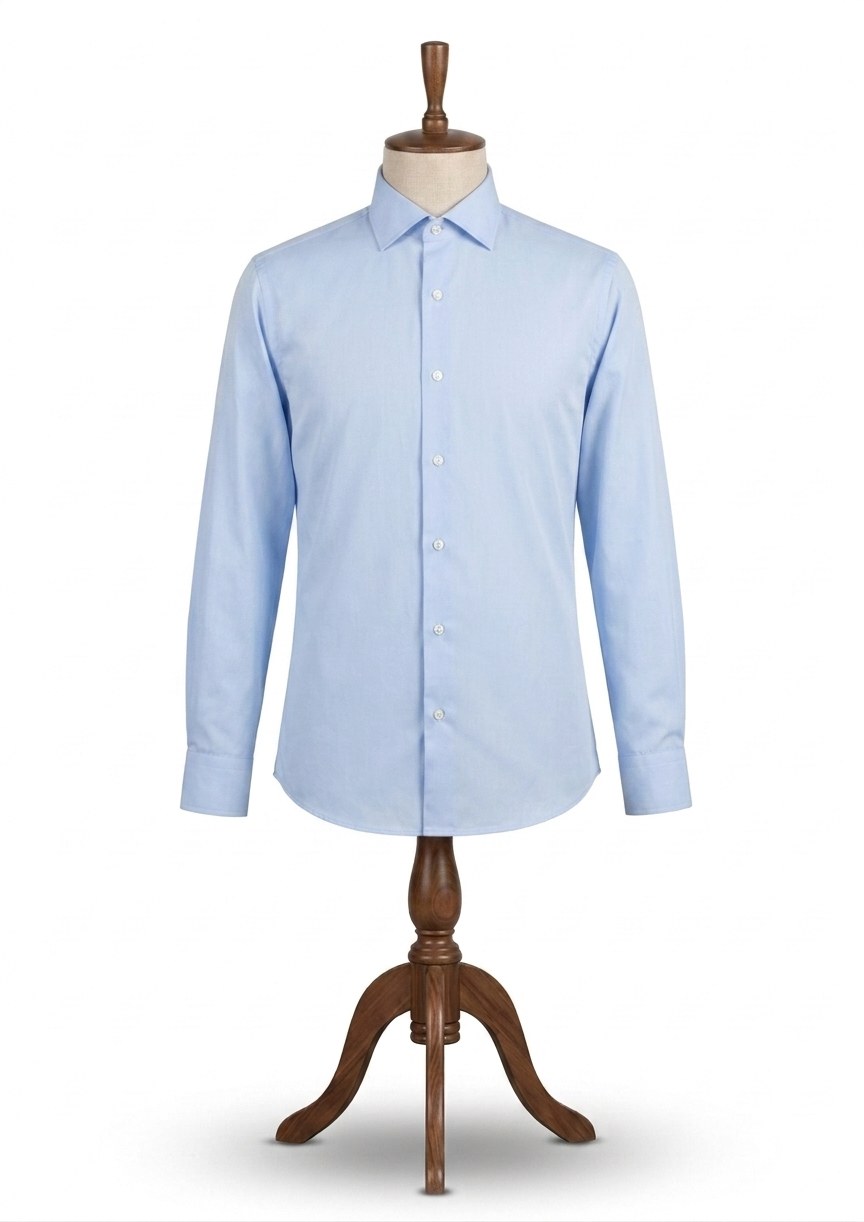
If you want one change that visibly improves how you look at work, have a shirt made. The cloth matters, but what you actually notice is the fit. A collar that sits against your neck without gaping or gripping. A cuff that lands on the wristbone. A chest you can button and then forget about. A standard shirt cannot promise you any of that, because it was cut to a standard body and yours is not one. We start from your measurements. If you would rather buy off our ready-made shelves, that is fine too, and our tailors will alter it for you here.
The three places fit is won or lost
Collar, shoulders and chest, cuff. Get those three right and the rest of the shirt tends to look after itself.
The collar should sit snug against the neck. Not gripping, not loose. With it buttoned you should get two fingers between the collar and your neck, no more and no fewer. A collar that stands away from the neck looks careless from across a table and feels worse. A collar that chokes is no better, and you will be undoing it by eleven. Getting it right needs a neck measurement taken with care and a collar pattern cut to that number, which is exactly what a standard size cannot give you.
The shoulder seam belongs at the end of your shoulder, not an inch down your arm. When it falls off the shoulder the whole shirt looks sloppy no matter how good everything else is. The chest needs enough room that the placket does not pull at the fullest point, but not so much that the shirt balloons when you tuck it in. These two work against each other. A fuller chest may need a wider body which then has to be brought back in at the waist, and a pattern cut for you deals with that from the start rather than as an afterthought.
The cuff should finish at the wristbone, where your sleeve meets your hand, leaving a quarter to half an inch showing beyond your jacket sleeve. That means a sleeve length taken from your arm rather than borrowed from whatever a medium is supposed to be.
What makes a shirting cloth worth paying for
We keep shirting from Thomas Mason, Alumo and David & John Anderson, three of the best names in the business, all of them weaving fine cotton in England and Switzerland with a few hundred years of practice between them.
Thomas Mason have been weaving in Lancashire since the eighteenth century. Their poplins, twills and Oxfords are the benchmark for what a shirt should feel like. Smooth, firmly woven, soft on the skin once it has been washed a few times, and able to hold a pressed line right through a working day. A 100/2 two-ply poplin from Thomas Mason is about as good as an everyday business shirt gets.
Alumo is Swiss, and they weave at the very top end. Their Sea Island cotton, Giza cotton and fine Swiss voiles are what you order when the shirt has to be exceptional. Pick up an Alumo Sea Island shirt and the handle alone tells you something has changed. Cool, smooth, faintly luminous, and nothing on any ready-to-wear rail feels remotely like it.
Come in and we will pull out the whole range, from the everyday cloths to the extravagant ones, tell you honestly what each is good for, and let you handle them yourself. Most people walk in intending to order one shirt and leave having chosen three cloths.
Collars, and how much they change a shirt
The collar is the part of the shirt everybody actually looks at, and it does more to set the character of the shirt than anything else. Every collar we make is cut to your neck measurement and set on a band sized so the stand height and the opening sit right on you.
The spread collar, with the two points opening wide apart, is the everyday choice for business. It takes a full knot comfortably, Windsor, half-Windsor or Pratt, and it still looks right when you pull the tie off at the end of the day. If you are ordering one shirt, order this.
The cutaway collar pushes the spread further, with the points sitting almost horizontal. It shows the knot off well and looks its best with a full Windsor. Bold, modern, and not for everybody.
The point collar is narrow, with the points nearly meeting. It is the traditional, slightly dressier option, and it belongs with a four-in-hand or a Pratt knot and a conservative wardrobe.
The tab collar carries a small tab joining the points behind the knot, which lifts the tie forward and gives it a distinctive set. Either a collar bar or a stitched cloth tab. It has a definite period flavour to it and is very much a considered choice.
The button-down collar fastens the points down to the shirt body. It is the most relaxed of the smart collars, tied up with Brooks Brothers and Oxford cloth, and it is perfect for smart-casual. In a very formal meeting it reads slightly off, and we will say so if you ask.