
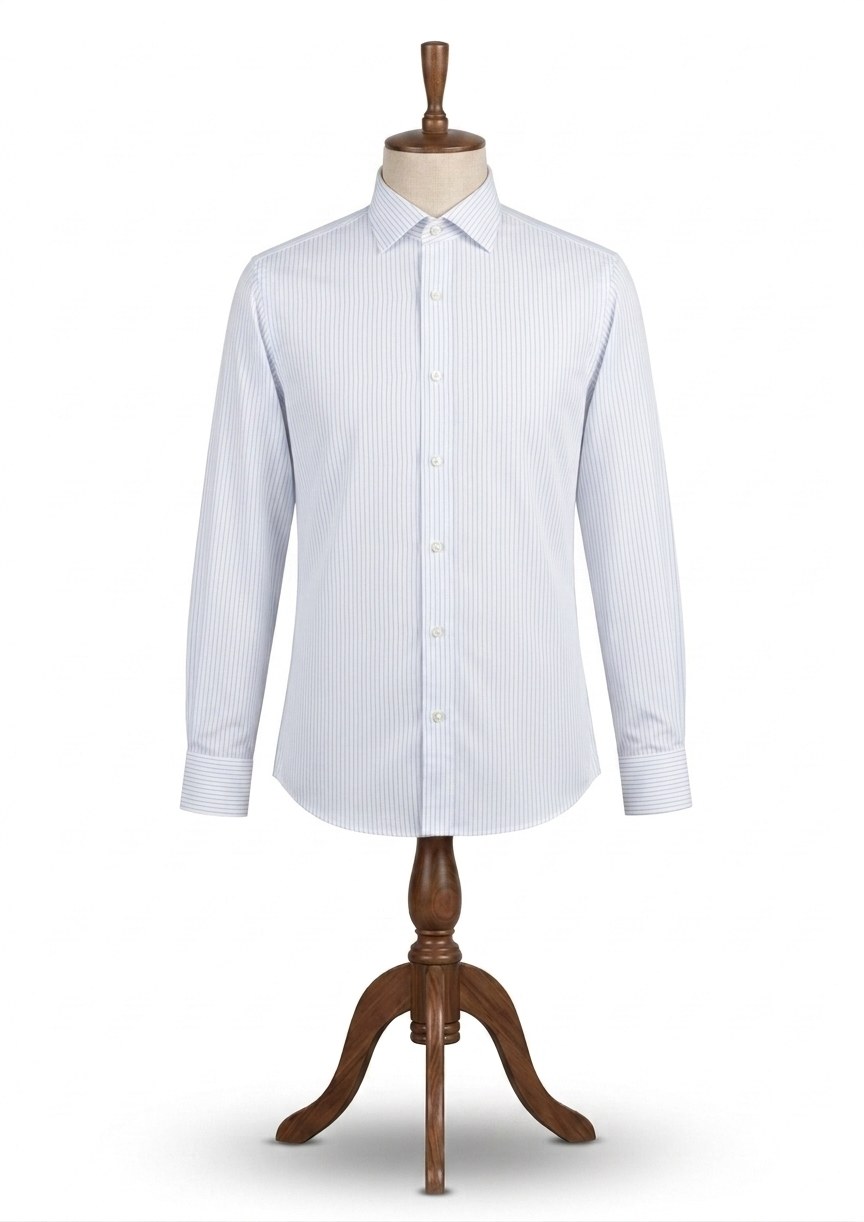
The business shirt does more work than anything else you own. It goes on more often, gets washed more often, and is seen by more people in more rooms than any jacket or tie. Which is exactly why it is worth getting right. A shirt made here is cut from cloth that survives long days and frequent laundering, fits without dragging across the chest or gaping at the collar, and is ready to wear when you pull it off the hanger at seven in the morning without you having to make allowances for it.
How it differs from a formal dress shirt
A business shirt lives between formal and practical. It does not have to be white the way a black-tie shirt does, but it does have to look right in a meeting room and across a table from a client, which rules out most of what people wear at the weekend. The range is wide. A blue poplin with a spread collar is fine almost anywhere in India. A striped version of the same shirt gives you pattern without stepping outside professional dress. A white one with a point collar and a French cuff gets you within touching distance of a proper dress shirt.
The real differences are the collar and the weight of the cloth. Business shirts happily take a wider range of collars, spread, point, button-down, and a far wider range of colours and patterns. The cloth is usually a two-ply poplin or twill: firm enough to take a press, light enough to wear through a Chennai working day without you thinking about it by three in the afternoon.
Building a set of shirts that actually works
White and pale blue will cover almost everything. White goes under every suit and behind every tie. Pale blue, in a poplin or a twill, is just as useful and softens you slightly, which is worth something in a room where you are trying to get people onside. Those two colours in a good poplin are the base of any working wardrobe, and most of our customers own several of each.
After that, the Bengal stripe, a bold alternating stripe in white and blue or pink or burgundy, is the classic business pattern. It gives you personality without leaving professional territory. A fine bar stripe or hairline is quieter again. Solid colours beyond blue, a mid-grey, a soft pink, a pale lilac, all work depending on what you do for a living and who you are sitting opposite.
Weight is the thing people get wrong here. In our climate a 100/2 two-ply poplin at around 80 to 90 gsm is about perfect: fine enough to feel cool on a July afternoon, firm enough to press well and keep its shape all day. A voile or batiste is cooler still but creases far more, so think about it. If you spend your day in a cold office, a slightly heavier twill at 100 to 110 gsm gives you more substance and looks better for it.
Why it is worth making this one to measure
Because you wear it daily, you notice the fit daily. The collar that gaps when you turn your head. The placket that pulls when you reach across a desk. The sleeve a centimetre too long that crumples over the back of your hand. None of these are disasters on their own, but repeated ten times a day, five days a week, they add up to looking slightly less put together than you actually are.
A shirt cut here fixes all three. The collar comes off your neck measurement, so it neither grips nor gapes. The body is shaped to your torso rather than to a size chart. The sleeve is the length that shows the right amount of cuff under your jacket. Most people order in multiples once they have seen the first one, three to five shirts off the same pattern in different cloths and colours, which is the sensible way to do it. And if you also want to pick a few off the ready-made shelf downstairs, our tailors will take them in for you, usually within the same week.