
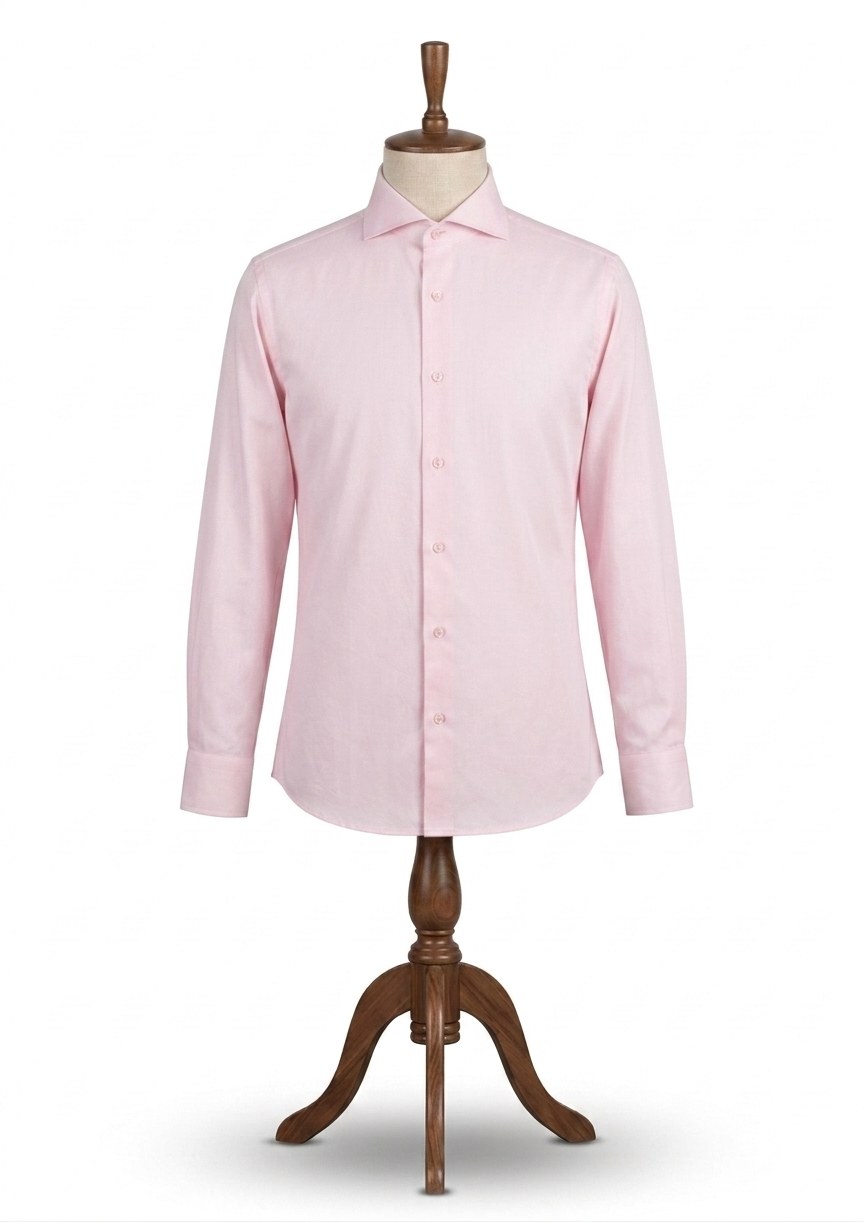
The collar frames your face and is the part of a shirt people look at most, yet it is chosen almost at random. The principle is simple: collar shape should counterbalance face shape. Wide spreads broaden a narrow face; narrower points lengthen a round one.
Semi-spread — the one to default to
Points angled moderately outward. It works with a tie or without, suits almost every face shape, and is appropriate in every setting from an interview to a wedding. If you own one style of collar, own this one. It accommodates any tie knot from a four-in-hand to a half-Windsor.
Spread and cutaway — for narrow faces and bigger knots
A spread collar opens the points further; a cutaway takes it to the extreme, with the points sweeping almost horizontally. Both create a wide frame that flatters narrow or long faces and balances a strong jaw.
Both demand a substantial tie knot — a half or full Windsor — to fill the gap. With a thin knot, or open-necked, a cutaway can look unfinished. If you rarely wear a tie, this is not your collar.
Point — for rounder faces
Narrow, with points angled downward. The classic conservative collar. The vertical line elongates and slims a rounder or wider face, which is why it flatters where a cutaway would not. Pair with a slim four-in-hand knot; a fat Windsor will force the points apart and spoil the line.
Button-down — casual, and not for suits
Points fastened to the body of the shirt with small buttons. Originally from polo, properly casual, and best on oxford cloth. Excellent under a sports jacket or worn open at the weekend; wrong under a formal business suit, and wrong at a wedding, whatever the internet tells you.
Club and band collars
The club collar has rounded points — a distinctive, slightly vintage look that is a genuine style statement rather than a default. The band or mandarin collar has no points at all, and sits naturally with Indian formal wear and with the smarter end of casual dressing. Both are worth owning once you have the basics covered; neither should be your only collar.