
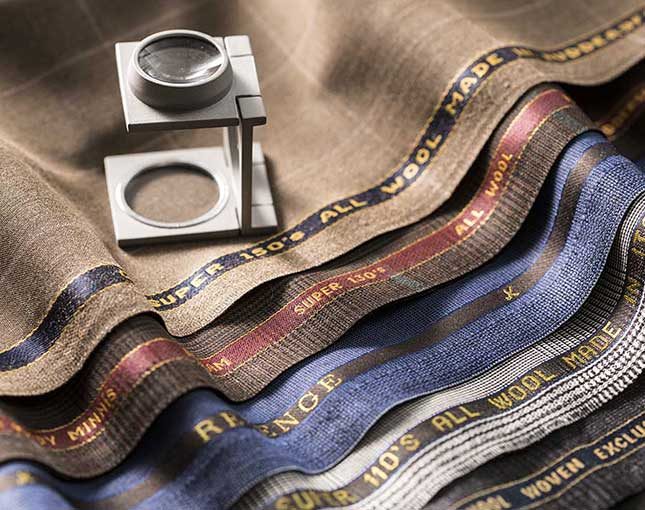
Gladson is not a mill, and we want to be straight about that from the first line, because plenty of people assume it is. Gladson is a New York cloth merchant. They buy from English and Italian weavers, hold enormous stock, and sell to custom tailors. That has been the business since 1948 and it is a legitimate trade with its own skill: choosing what to carry, in what weights, in what colours, and standing behind it. Their book is built for tailors in a country with hot summers, which is why it has more that suits Chennai than most European merchant ranges do. Fresco, Irish linen, seersucker and cotton all sit in the main collection rather than in a token summer appendix.
A merchant, not a mill, and why the difference matters
There are three kinds of business behind any bunch on a tailor's counter. There are mills, which own looms and turn fibre into cloth. Vitale Barberis Canonico and Zegna are mills. There are cloth houses, which commission weaving to their own specification and put their name on it. Holland & Sherry, Scabal and Dormeuil work that way. And there are merchants, which buy finished cloth from many sources, hold it in depth, and sell it on. Gladson is the third kind.
None of those is better than the others. They do different jobs. A merchant's value is in the editing and in the stock. Gladson decide what an American custom tailor will actually sell, buy that in quantity, and hold it in a warehouse so a single suit length can ship the week you order it. Their distribution centre is at Secaucus in New Jersey and their showroom is at 720 Fifth Avenue in Manhattan, at 57th Street.
What this means for you is depth and availability rather than exclusivity. We would rather tell you that than dress it up. If you want a specific cloth house's own weaving, ask for Dormeuil or Scabal. If you want a broad, sensibly chosen book with real stock behind it, Gladson is a good place to look.
Gladys and son, 1948
The story starts in the late 1930s, when Benjamin Solomon and his four brothers were selling English cloth out of Manhattan warehouses. The company proper was founded in 1948 as Gladson of England. The name is a joining of Ben's wife Gladys and the word son, which is a more charming origin than most textile brands can manage. Ben's sons Herbert and Mickey came into the business later, both with textile design degrees behind them.
Since 1974 Gladson has operated under HMS International Fabrics Corporation, and it now runs offices in England, Canada, China and India as well as New York. In 2009 HMS acquired Huddersfield Fine Worsteds in the United Kingdom, which brought historic Yorkshire mill names including Broadhead & Graves and Learoyd Brothers into the same group.
That last point connects to another bunch already in our cloth room. Roger La Viale, the British performance suiting range we recommend for travellers, is a division of Huddersfield Fine Worsteds, which makes it a sister operation to Gladson under HMS. So is Hardy Minnis. Worth knowing when you are comparing the two books at the counter, because the family resemblance in how they think about cloth is not a coincidence.
The book: Fresco, Irish Linen, seersucker and the rest
Gladson's range is organised into named collections, and the suiting side is the deepest part of it. Fresco is the one we reach for most in Chennai. Fresco is a construction rather than a brand, a high-twist open weave that lets air through and resists creasing, and Gladson carry a bunch of their own in it. If you have read our Holland & Sherry page you already know why we care about this cloth here.
Irish Linen, Seersucker and Sunny Season Classics are the rest of the warm-weather answer, and they are carried in real depth rather than tucked away at the back. Quest Cotton covers cotton suiting for the less formal end. For anyone who wants a summer jacket or a light suit that is not wool, this is one of the better books we can open.
Higher up, Gladson carry Carlo Barbera, one of the great Biellese weavers, and cloth from Vitale Barberis Canonico. The jacketing side runs to Harris Tweed, Portofino, Pure Cashmere and Bamboo III. Trousering sits under Blasone, Eskdale and Super Gabardine, and the formal collections, Black Tie and Saratelle, cover dinner suits and the festive end.
They carry shirting too. The Sprezzatura dress and sport shirtings are the house lines. We will show them to you, though for a bespoke shirt we usually point you at Albini, Thomas Mason, Alumo or Söktaş first, and we will explain why when you ask.
When Gladson is the right call
Gladson suits two customers. The first is the man who wants a warm-weather suit or jacket that is not wool. A linen, a seersucker, a cotton, something for a daytime wedding in May or for a job where a full worsted suit would be absurd. The Gladson book handles that better than most European merchant ranges, because it was assembled for a market that actually has a summer.
The second is the man who wants breadth. Twenty-odd suiting collections and a dozen jacketing ones is a lot of ground, and if you have already looked through the European bunches without finding the exact grey or the exact check you had in mind, this is a sensible next place to look.
Where we would not send you to Gladson is when the brief is a single occasion suit in the finest cloth available. For that we open Scabal, Dormeuil or Zegna, and we say so.
Gladson cloth is available to order through us. Tell us what the garment is for, and we will pull the relevant collections and put them on the counter next to the mill bunches so you can compare cloth against cloth rather than name against name.