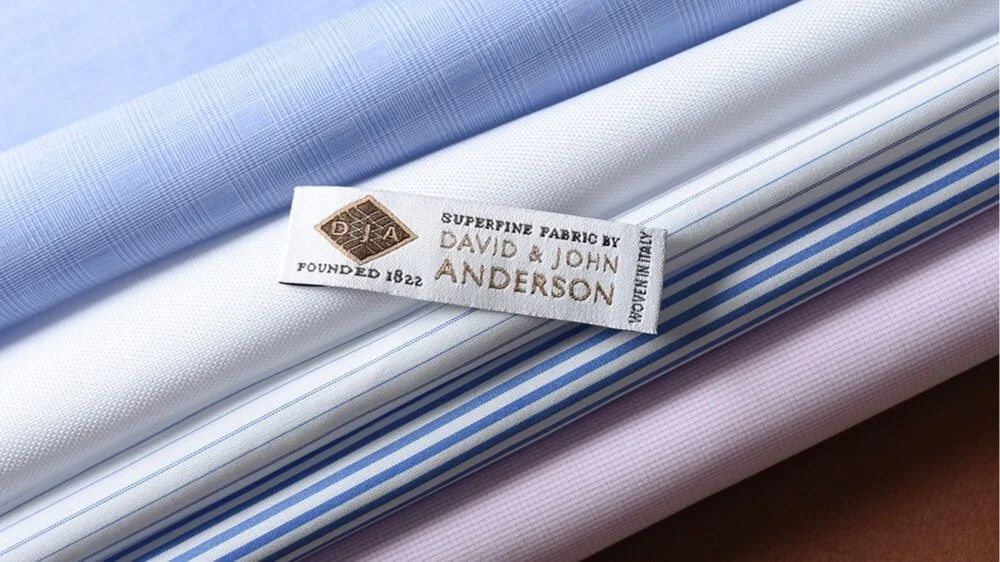
David & John Anderson set up their textile operation in Scotland in 1822, in the tradition of Scottish fine weaving that had distinguished the country for centuries. Their strength is formal and dress shirting: the fine poplin, the pure white twill, the dress fabrics that formal shirt-making is built on. Anderson cloth has a crispness and a precision in the weave that makes it the right pick when a shirt has to hold its form through a long evening, take a heavy press without complaint, and look the same at midnight as it did at seven. In a city with as many weddings as this one, that is a useful thing to have on the shelf.
Two centuries of Scottish formal cloth
Scottish textile manufacturing sits apart from the English tradition. Where the cotton mills of Lancashire and Cumbria grew up around volume production, Scottish fine weaving, particularly in Lanarkshire where D&J Anderson operate, built its name on the quality and precision of the cloth rather than the size of the run. You can see that in the cloth itself. It was never meant for everyday volume shirting. It is for the shirts you think about beforehand.
The Anderson family started up in 1822, when the hardening of professional and social dress codes in Britain was creating demand for shirting that could stand up to a formal culture. The dress shirt, with its stiff front, its exact collar and the requirement to hold its form through events lasting hours, needed cloth of a specific construction: crisp, stable, able to take heavy pressing without distorting. Anderson cloths have answered that brief for two hundred years.
The Anderson character: crisp, not stiff
The easiest way to describe Anderson cloth is by comparison. Thomas Mason has weight and substance, the confidence that comes from two-fold construction and a long British tradition. Alumo has smoothness and refinement, Swiss precision aimed at comfort against the skin. D&J Anderson has crispness, a structural quality in the weave that suits a formal shirt which has to keep its shape and its press through a long wearing.
Crisp is not the same as stiff. A well-laundered Anderson shirt does not feel like cardboard. What it does is stand its collar correctly, keep the front flat instead of rolling, and hold the line of the iron exactly where you put it. For a dress shirt, whether for black tie, a board presentation, or the formal occasions that come round constantly in Indian professional life, that is a quality neither the Alumo smoothness nor the Thomas Mason weight quite delivers.
Poplin, twill and the dress fabrics
Anderson are strongest in the constructions that define formal shirting. Their poplin, a plain-weave cotton in fine thread, is the foundation of formal shirting in the Western dress tradition. Anderson poplin has a slight sheen off the fine weave, a crispness in the surface that reads correctly against a dark suit and a satin tie, and a press that survives a long function.
Their fine twill keeps the house formality while adding a quiet diagonal texture that separates the shirt from a plain poplin. In white or the palest blue it works for anything up to and including formal business occasions.
For dress shirting proper, the front placket shirt for a wedding, the shirt for a black-tie dinner, the high-formality shirt for a major professional event, Anderson weave the specific fabrics that context needs: fine marcella for traditional formal shirt fronts, and the fine plain cloths a detachable collar requires.
When we put you in D&J Anderson
Anderson is for the formal occasion shirt: the wedding, the high-formality corporate event, the black-tie or white-tie evening, or anything where the shirt is expected to be exactly correct and to stay that way until the end of the night.
For everyday work shirting, Thomas Mason and Alumo cover the ground better. Anderson cloth is meant for the handful of shirts the formal side of your life demands, not the five that go through the wash every week.
In India that handful matters more than it does elsewhere. Weddings, religious celebrations and formal corporate evenings fill the calendar, and a lot of our customers order an Anderson dress shirt alongside a bespoke ethnic garment. The white formal shirt that has to work with a bandhgala at the reception, or with a suit at a corporate function, has to be as precisely right as the garment it sits under.
We bring out the Anderson bunches at the shirt consultation whenever the order involves an occasion garment, and we choose between Anderson, Thomas Mason and Alumo one shirt at a time, based on what each one is actually for.