
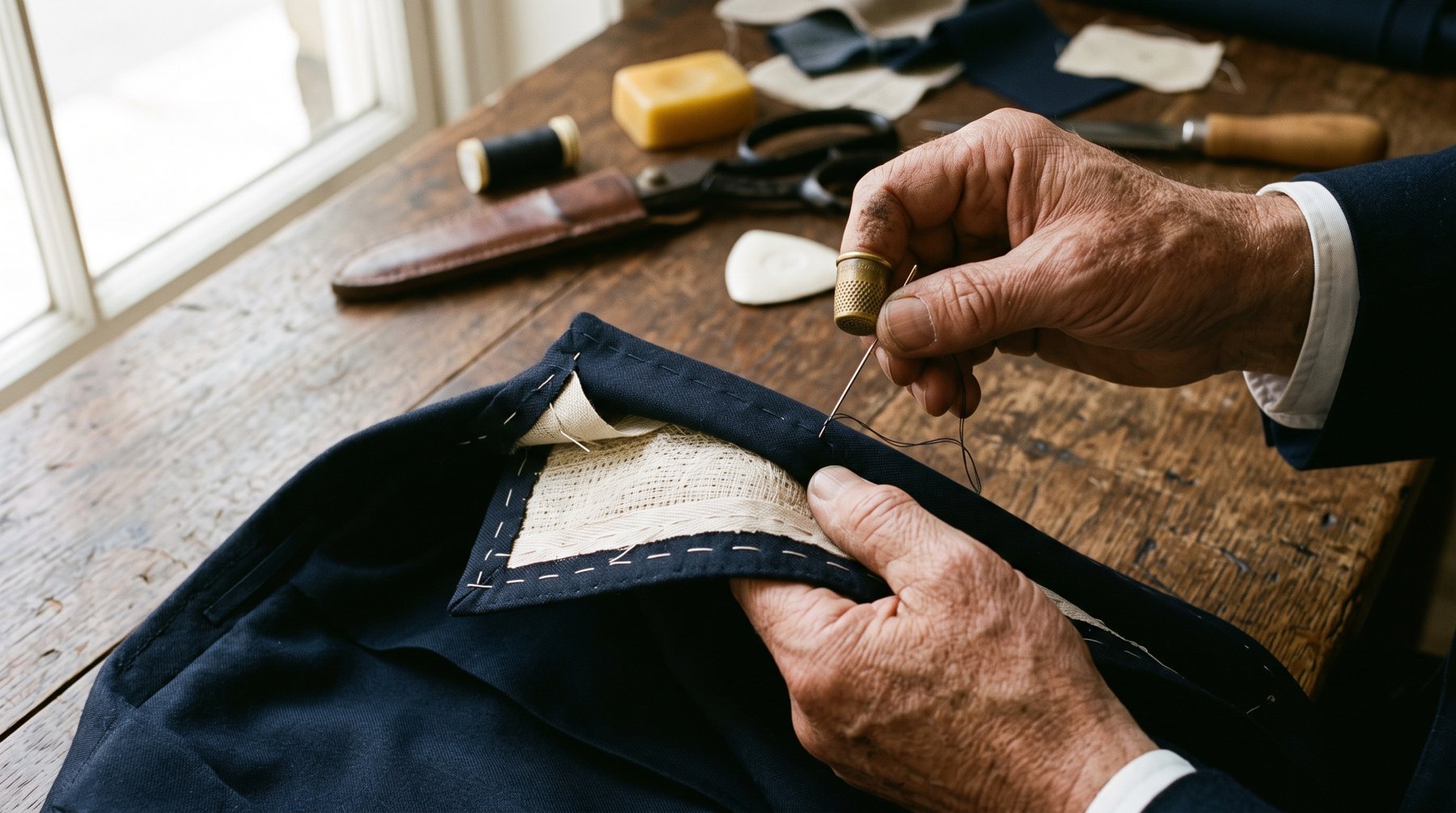
Every claim a tailor makes comes down to the people at the bench. Ours have been here a long time. They cut the bespoke, they take in the shirt you bought off the rail an hour ago, and they are the reason customers who came in once in 1999 still come in now. This page is about them, because they are the thing that actually distinguishes one tailoring shop from the one down the road.
The cutter
The cutter matters most. His job isn't to measure you — a tape does that. His job is to read you: how you carry your weight, how you stand, which shoulder sits lower, what has to be built into the pattern to account for a body that, like everyone's, isn't symmetrical. From that reading he draws your pattern.
Drafting is a skill that only comes with years. A cutter who has been making jackets for two decades carries a mental library of fixes — the high left shoulder, the sway back, the dropped seat, the sleeve that pitches forward — that a cutter two years in simply hasn't collected yet. Ours built that library here, on customers from this neighbourhood, over almost thirty years.
He cuts the cloth too. Marked out and cut by hand with shears, one layer at a time, checked as he goes. It's slower than a machine cutting through a stack. It's also the only way to respect the direction of a weave, line up a stripe or a check across a seam, and keep the nap running the right way on velvet.
The tailors
Once the cloth is cut it goes to the tailors. Some of the work is machine-sewn, because a machine makes a stronger, straighter seam than a hand does. The rest is hand work, because a hand does it better: the chest canvas, the lapels, the collar, the buttonholes, the final press.
Padding a lapel by hand is the clearest example. On a good jacket the lapel rolls rather than lying flat, and it shifts slightly as you move. That roll comes from hundreds of small stitches that compress the canvas along the roll line. No machine does it. A tailor with the training and enough years behind him produces a lapel that keeps its roll for as long as the jacket exists.
Most of our tailors have been here for years, several for decades. That continuity is why our garments look like ours — the way a shoulder is set, how much the waist is taken in, where a chest is cut. Nobody wrote it down. It passed from bench to bench.
The fitters
At the basted fitting, the fitter reads the garment on you and marks what has to change. It's a diagnostic job. He has to see the fault in front of him and know which pattern correction will fix it once the garment is put back together — not the same thing, and the difference is experience.
A good fitter can tell whether a problem came from the pattern, the cutting or the cloth, and knows the right answer for each. He can also tell the difference between what the garment needs and what the customer thinks it needs, which are frequently not the same. Handling that conversation is part of the job: listen, explain what you're looking at, then recommend the change that will actually work rather than the one that was asked for.
How the skill gets passed on
You can't learn this from a book. It goes from person to person — working next to someone who knows, trying it, getting it wrong, being corrected, trying again, and eventually being trusted with something that matters. It takes years, and there's no way to shorten it.
At Sellers the senior men trained the younger ones, exactly as they were trained. The way we cut a lapel, set a sleeve, handle a tricky fit — all of it came down that line. The people at the bench today are carrying methods that arrived here in 1997 and have been refined on every garment since.
That's what "since 1997" means when we say it. Not that a shop has kept its shutters open for nearly thirty years, but that nearly thirty years of accumulated skill is standing in the room when you walk in. Including, incidentally, when all you want is a pair of trousers shortened.