
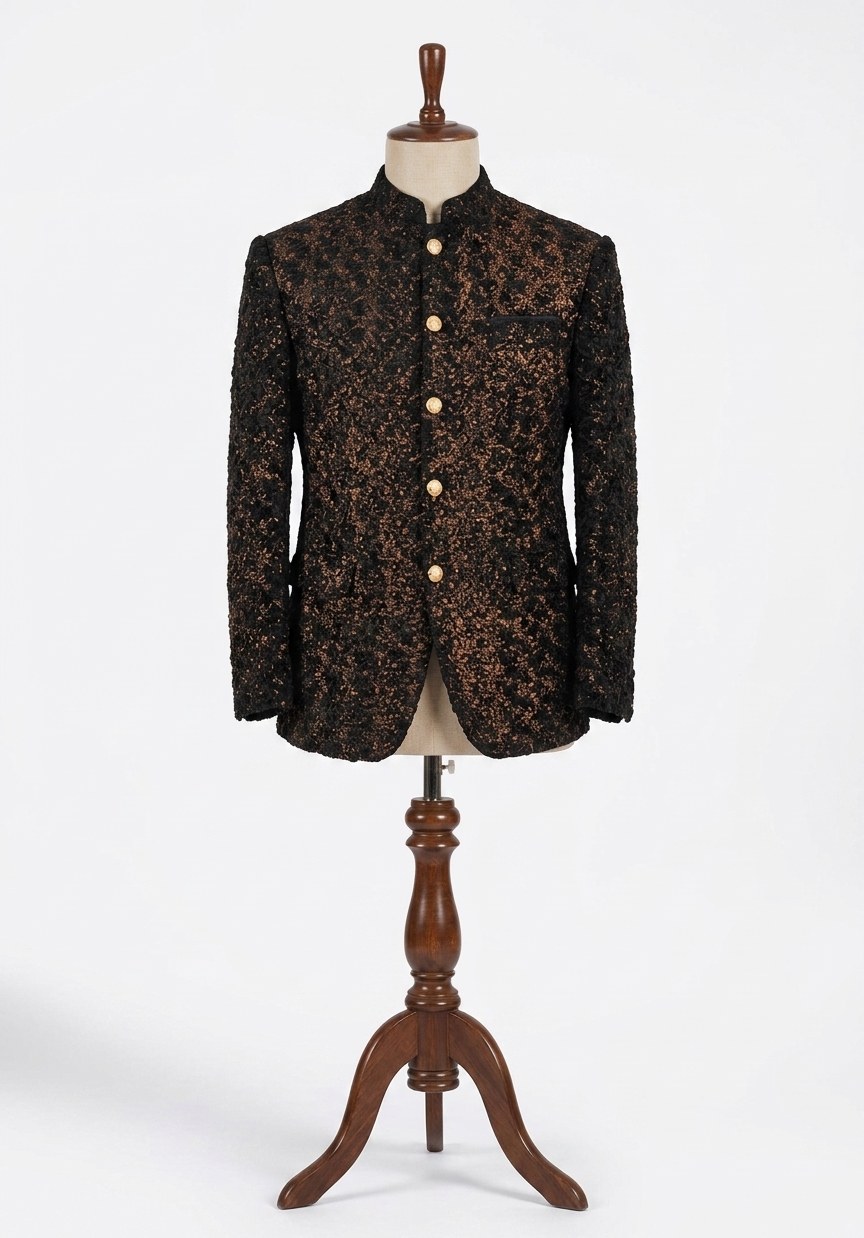
The sherwani and the bandhgala are the two heavyweights of Indian formal dress for men, and people use the words interchangeably all the time. They shouldn't. The two differ in length, in construction, in how formal they are, and in where each one belongs. Once you can see the difference you stop guessing at invitations, and you stop buying the wrong one. Here's how we explain it across the counter.
Length, formality and construction: the three differences
Length: a sherwani is a long coat, dropping to the knee or below, sometimes to mid-calf, worn over the churidar and kameez. A bandhgala is a short jacket finishing at the hip, about where a Western suit jacket finishes. That one difference is the first thing anybody sees, and it decides most of what follows about when each is appropriate.
Formality: the sherwani sits higher. Its length, its richer cloth and its association with the groom put it at the top of the scale. The bandhgala is formal but far more flexible: it works at the office and at the ceremony, in suiting wool and in silk, for a client meeting and for a wedding reception. If you can only own one, this is why it's the bandhgala.
Construction: the sherwani's length demands a specific build. The body has to be shaped to fall correctly from the shoulder for a metre or more, the collar and the button run have to stay in line the whole way down, and any flare at the hem has to be built into the pattern rather than added later. A bandhgala is closer to a Western suit jacket and can be built with much the same techniques.
When to choose a sherwani, and when a bandhgala
Take the sherwani when you're the groom, or when the occasion sits right at the top of the Indian formal scale: a wedding where you're immediate family, a state or diplomatic evening in Indian dress, a major religious function. The length and the richness announce that this is the most important thing on your calendar, so don't wear one to an evening that isn't.
Take the bandhgala when you want Indian formal dress that travels: boardroom to wedding reception, formal dinner to political function. It covers more ground correctly than the sherwani ever will. If a customer tells us he wants exactly one formal Indian jacket in his cupboard, we put him in a bandhgala every time.