
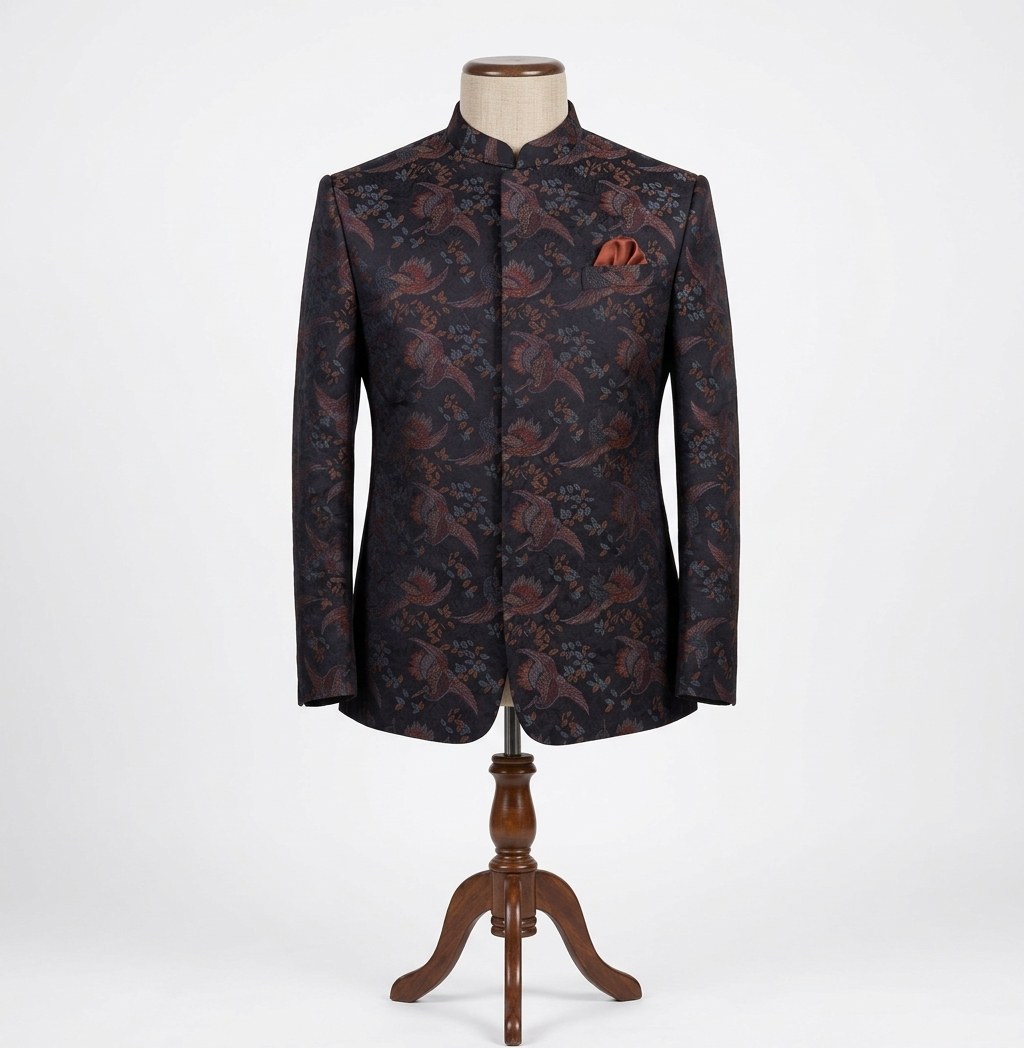
Indo-Western isn't a type of garment, it's an approach: putting Indian and Western pieces together on purpose so the result looks like one outfit rather than two arguments. A Nehru jacket over a plain white shirt and dark trousers. A kurta with slim Western trousers. A bandhgala finished with Oxfords instead of jutti. Done with some judgement it's the sharpest way an Indian man can dress for work and for evenings. Done carelessly it looks like you got dressed in the dark. We make the pieces at Sellers and, just as usefully, we'll tell you honestly which combinations are worth your money.
The combinations that actually work
The pairings that hold up are the ones where each garment is wholly itself. A fine silk Nehru jacket over a white dress shirt and dark formal trousers: the jacket is entirely Indian in its collar and its cut, the shirt and trousers entirely Western. Nothing has been compromised to meet in the middle, and that's exactly why the outfit looks intentional rather than improvised.
The same logic applies to a good kurta over slim Western trousers or straight chinos. The kurta does its job as an Indian upper garment, the trousers do theirs, and neither has to pretend. Watch the length relationship, though: the kurta needs to reach at least the thigh, or you get the awkward short-top-over-formal-trouser look that ruins the whole thing.
The combinations that don't work, and why
Indo-Western goes wrong when the hybridising happens inside a single garment instead of between two of them. A jacket carrying both lapels and a stand collar looks like a factory error. Kurta prints applied to Western-cut shirts end up being neither. And a formal sherwani or achkan worn with Western shoes instead of jutti or good sandals creates a clash at the floor that pulls the whole outfit down with it.
The other reliable failure is mismatched formality: a brocade bandhgala over jeans and trainers. Keep both halves at roughly the same level. Formal bandhgala with formal trousers and dress shoes; casual kurta with chinos and loafers. It isn't complicated, but it's where most people slip.
Why this is where made-to-measure earns its money
Indo-Western dressing depends more on a well-cut Indian piece than on anything else. A Nehru jacket that sits properly over a shirt has to allow for the shirt collar underneath, which is a different fit from a Nehru worn over a kurta. A bandhgala meant for Western trousers wants a jacket hem, not the longer Indian one. Those adjustments are routine when we're cutting from your measurements and effectively impossible on a ready-made piece built for one traditional use.
Customers who want to build this kind of wardrobe usually start with one or two Indian pieces, a Nehru jacket and a bandhgala, chosen with their existing shirts and trousers in mind. Bring the trousers in with you. We'll set the cloth, the proportion and the details around what you already own, which is the difference between a jacket that joins your wardrobe and one that sits in it alone.