
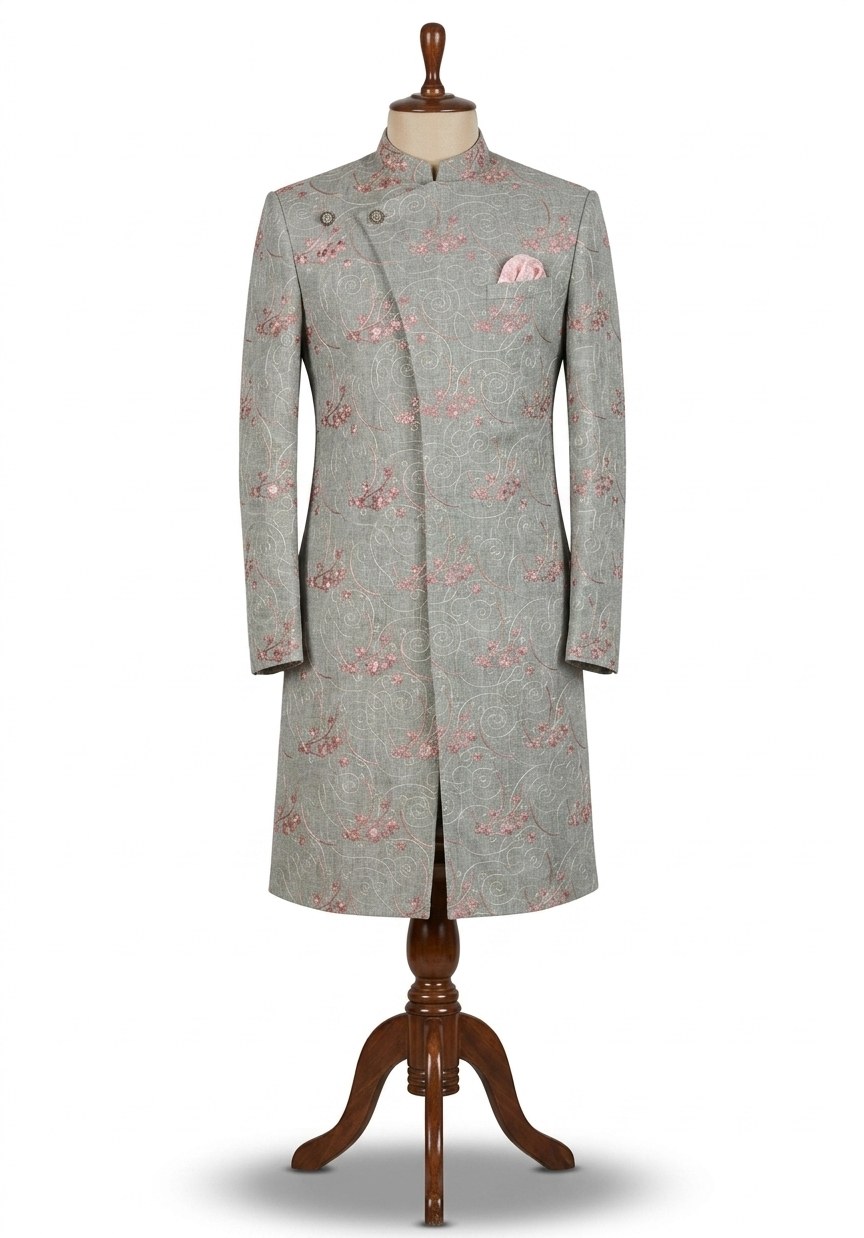
Indian tailoring has a history as long as the subcontinent's cloth. The achkan and the sherwani come out of the Mughal court workshops of the sixteenth and seventeenth centuries, where craftsmen worked out garment traditions still recognisable on a mandap today. Western suit tailoring arrived with the Raj and was taken up, adapted and eventually mastered by Indian tailors who many customers came to rate above the British houses that taught them. Sellers is a small part of that long story: Mukesh Bhambhani opened the shop on Sardar Patel Road in Adyar in 1997, and the workshop behind our ready-made floor still cuts by hand for Chennai families who have been coming to us for three decades.
The Mughal court and where Indian tailoring begins
The Mughal court between the sixteenth and eighteenth centuries was among the greatest patrons of cloth and clothing anywhere in the world. Akbar alone ran karkhanas employing thousands of artisans, tailors among them, turning out angarkhas, jamas, sherwanis and achkans whose basic shapes you can still recognise in what men wear to weddings today. The embroidery traditions that go with Indian dress, zardozi, resham work, chikankari, were refined and codified in those workshops and have been handed down through unbroken craft families since.
The stand collar on the bandhgala and the sherwani, the single most distinctive thing about Indian formal menswear, came from the Mughal nobility taking up Persian court dress, where a closed collar signalled rank. When the British came and the court culture fell away, the collar and the long coat survived, because by then they were part of how Indians understood themselves rather than merely a fashion.
The Raj, the suit, and the trade that came after
The Raj brought Western suit tailoring to India systematically. Tailors serving the civil and military administration learned Western cutting and construction, and in Bombay, Delhi and Calcutta some of them got very good indeed. By the early twentieth century, Indian-trained tailors were making suits of real quality for Indian customers who wanted Western professional dress on weekdays and Indian dress for ceremony and home.
Partition then shuffled the whole trade. Cutters moved cities, Lahore's tailoring community largely relocated to Delhi, and skills spread with them. Chennai's own tailoring trade grew from that same century of exchange, and by the time Mukesh Bhambhani opened Sellers in Adyar in 1997 the city had a deep bench of cutters and finishers to draw on. Nearly thirty years later we still keep the workshop and the ready-made floor under one roof, which means the tailors who cut a wedding sherwani are the same ones who take in a jacket you bought off our rail, usually within the week.