
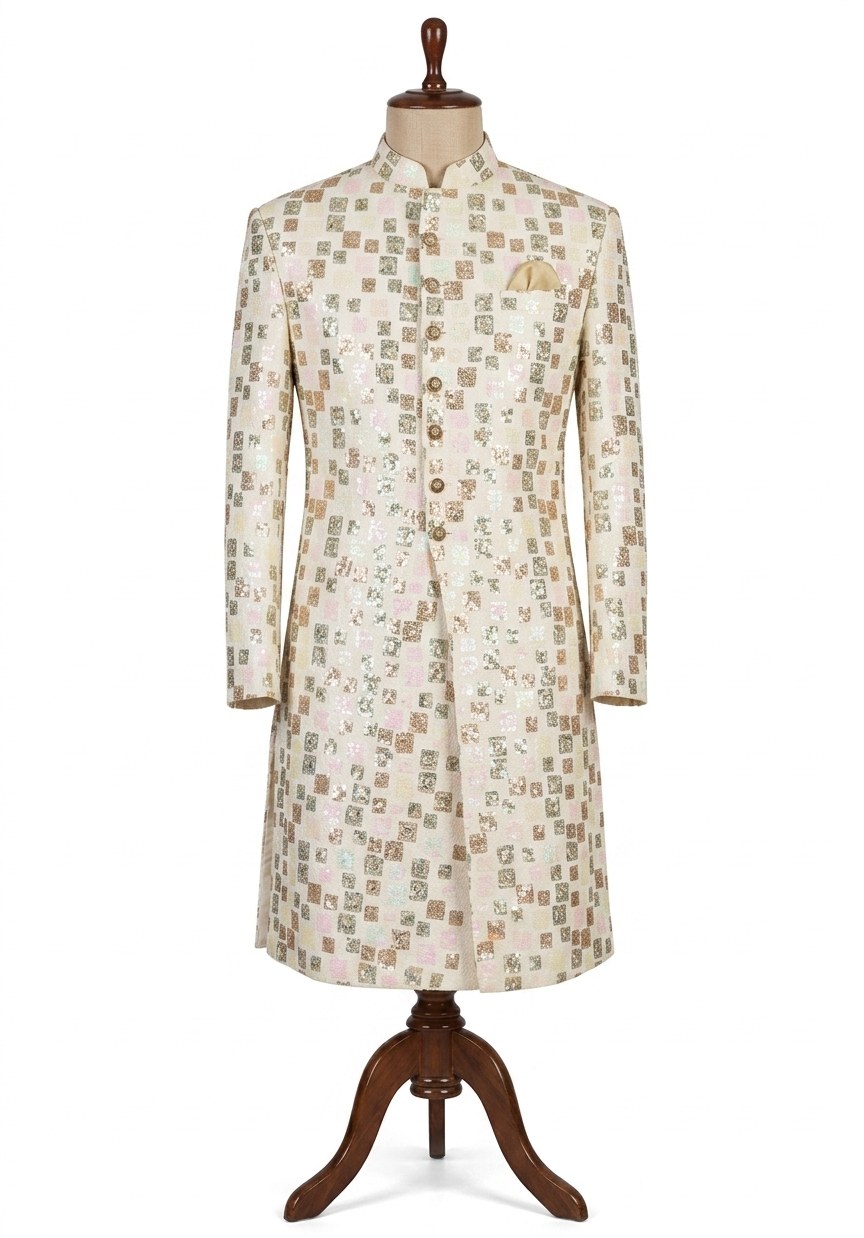
South Indian weddings look nothing like the North Indian weddings that fill Indian wedding media, and dressing for one on the strength of Instagram is how grooms end up looking slightly out of place in their own photographs. Down here the formal palette is ivory, cream and gold; the cloth comes from South Indian looms; the whole visual grammar of the ceremony is different. Choosing a sherwani for a South Indian wedding means knowing which tradition you're dressing for, Tamil Brahmin, Tamil Christian, Telugu, Kannada or Malayali, and what will look right standing in that particular mandap. We've been dressing Chennai families for weddings since 1997, so ask us.
How the South Indian wedding differs from the North Indian one
Tamil Brahmin, Tamil Hindu and Malayali traditions lean heavily towards off-white, cream and gold for the groom. The most traditional outfit is still the dhoti with the angavastram over the shoulder. The sherwani is a North Indian garment by origin, and although it's been adopted right across the country, it reads slightly differently here: more as a formal statement for the reception, or for ceremonies happily mixing the two aesthetics, than as the ceremonial default.
For a Tamil Brahmin wedding, an ivory or cream sherwani with restrained work, or with South Indian gold zari rather than North Indian thread embroidery, sits far better than a heavily worked Delhi-style coat. For a Tamil Christian wedding, white or light grey with silver detailing matches the palette of the ceremony. Telugu and Kannada weddings carry more variety, and there a richer colour with more embellishment is both appropriate and increasingly common.
Cloth for the South Indian groom
South Indian silk weaving, Kanjivaram, Dharmavaram, Thanjavur, produces cloth with a different character from North Indian silk. Kanjivaram is heavier, densely woven, bold in its patterning. Dharmavaram is a shade lighter and takes more kindly to a structured garment like a sherwani. Both bring the gold zari borders and body patterns that South Indian formal dress is built on, and both look right in a temple setting in a way an imported cloth does not.
At Sellers we source South Indian silk specifically for grooms whose ceremony calls for it: men who want a bespoke sherwani cut properly, in cloth that actually belongs to the tradition they're marrying into rather than a Varanasi fabric flown south and hoping nobody notices. It's a small difference in the shop and an obvious one in the photographs.