
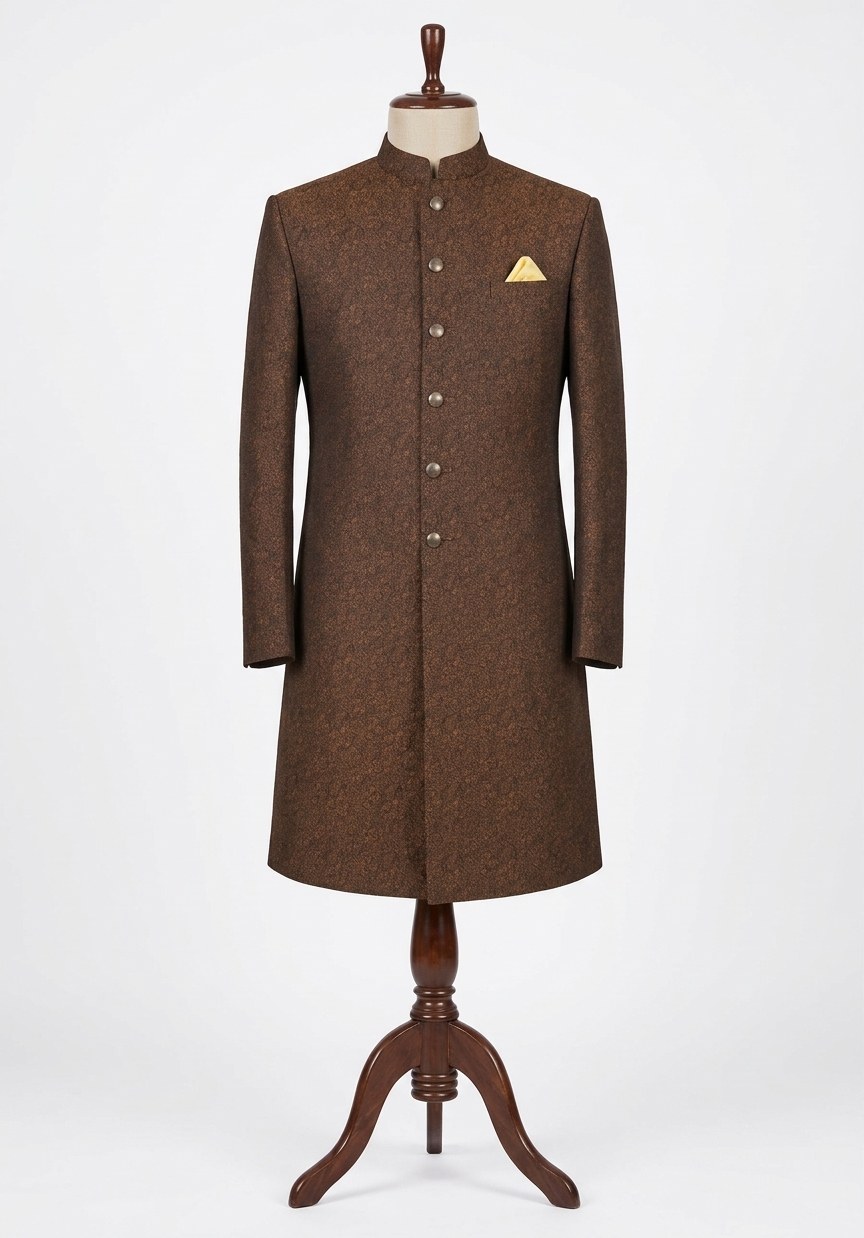
The North Indian wedding sherwani, in brocade or worked silk, usually ivory, cream or a deep jewel tone, is the template everybody pictures when they hear the word sherwani. It sets the visual standard for the day, and every other outfit in the room is judged against it, whether anyone admits that or not. It's the single most consequential clothing decision a North Indian groom makes, and we make a fair number of them in Chennai for families who've moved south or who are marrying into the city.
The classical North Indian groom's sherwani, and what has changed
Traditionally it's cream or ivory, a colour tied to beginnings and to auspiciousness, and it's worked heavily in gold, whether zardozi or thread embroidery: at the collar, down the placket, at the cuffs, and often across the chest and shoulders in an all-over pattern. The churidar matches in ivory or cream silk. A Rajasthani groom finishes it with a sarpech in the turban, a Punjabi groom with the sehra over the face, and both with jutti worked in gold or silver.
That template has loosened a lot in the last decade. Pastels, blush, mint, pale lavender, are now common for grooms who want colour without the heaviness of a jewel tone. Silver work has taken over from gold for men with a cooler eye. And plenty of grooms now ask for black or very dark navy with almost no embellishment at all, going for authority instead of ornament. All of those are perfectly correct; the only wrong answer is the one that doesn't suit the man wearing it.
Ordering a North Indian style sherwani from Adyar, Chennai
We make sherwanis at Sellers across the whole range of North and South Indian wedding traditions. For North Indian coats we buy brocade and worked silk through suppliers we've used for years in Varanasi and Delhi, and the embroidery goes to karigars whose work we've checked ourselves. Nothing gets ordered from a photograph and hoped for.
Construction runs the same way as everything else we make: measurements, pattern, first fitting on the basted shell, embroidery onto the panels, building up the coat, final fitting. The three-month minimum matters most on an embroidered sherwani, because the embroidery adds weeks that have nothing to do with the tailoring. Come to us as soon as the date is fixed. A year ahead isn't early, it's comfortable.