
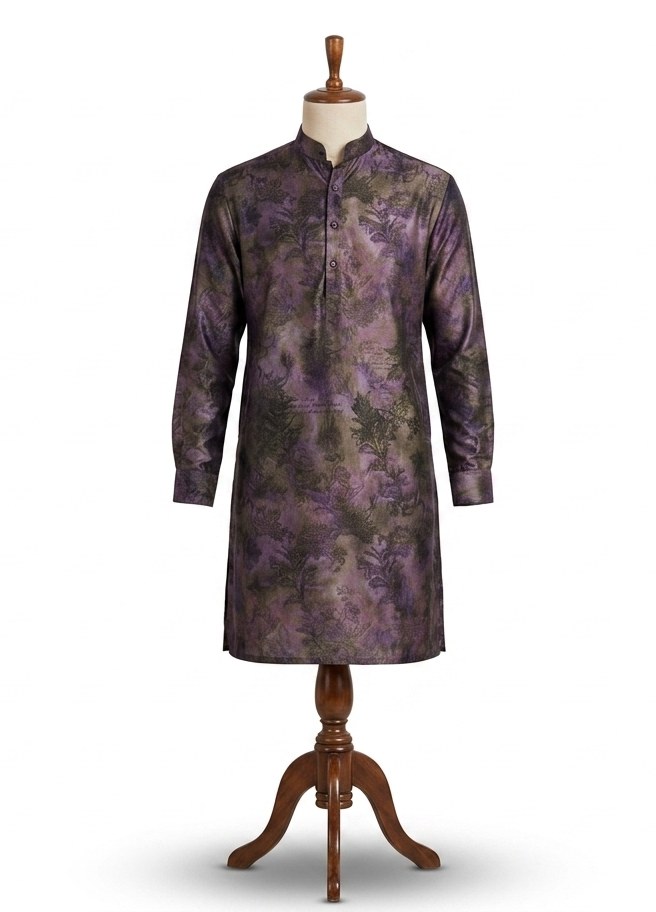
Dupion, also written douppioni, is woven from double-cocoon silk, fibre from two silkworms that spun together, which gives an uneven double thread. What comes off the loom has a distinct ribbed irregularity, more pronounced than the slub of raw silk, with a crisp body and a horizontal unevenness running across the weave. It gives you the shine of processed silk and the surface interest of a textured cloth at once: livelier than plain silk, more polished than raw silk, and sitting neatly between the two in where it belongs.
What makes dupion look the way it does
The surface is slightly irregular, ribbed so it catches light differently across the weave, and that's what gives dupion a depth plain silk never has. The irregularity runs one way: the weft threads carry the texture, the warp stays smooth. So the cloth looks rich and solid head-on and shows its ribbing the moment you see it at an angle, which is most of the time in a room full of people.
Its crispness is the thing you notice in the hand. Where smooth mulberry silk pours, dupion has body. It takes a crease, it keeps its shape in a structured garment, and it builds a clean, almost architectural line in a bandhgala or a Jodhpuri jacket. If shape matters more to you than fall, dupion is the silk to ask for.
Where dupion silk works in Indian ethnic wear today
Its body and texture make dupion a natural for the bandhgala and the Jodhpuri suit, where structured construction wants a cloth that holds itself up. A charcoal or navy dupion bandhgala looks quite different from the same jacket in plain suiting wool or smooth silk: the texture adds interest while the crispness keeps the lines sharp all evening.
On sherwanis, dupion sometimes goes underneath embroidery, where its texture plays nicely against the smoothness of the thread. As a kurta it gives you a semi-formal garment with a good deal more character than plain silk. The colours suit it too, particularly in South Indian weaving: deep teals, rich burgundies, royal blues, and the warm ivories and champagnes that Tamil Nadu has been weaving for generations.