
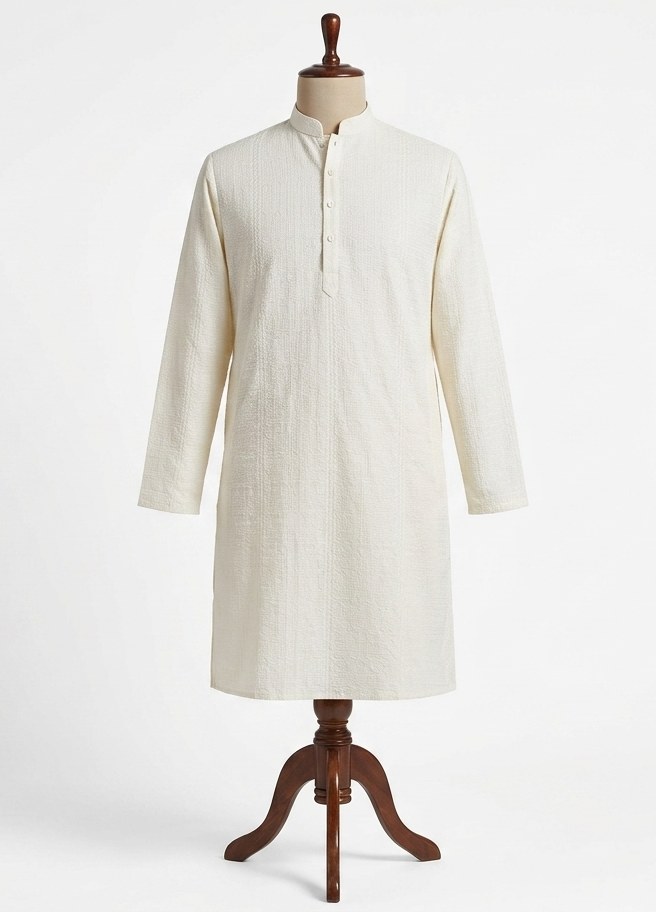
Cotton is the cloth this subcontinent runs on. India's textile history is a cotton history, from the muslins of Dhaka to the handloom traditions of Tamil Nadu and Andhra to the voiles and poplins on our shelves today. A cotton kurta cut for you at Sellers comes from our shirting and kurta cloth: handloom cotton in naturals and dyed colours, fine voile for the months when Chennai is unreasonable, mercerised cotton if you want a little lustre, or khadi, which carries more history per metre than anything else in the shop.
Cotton cloth for kurtas, from voile to handloom
Voile is a very fine, semi-sheer plain-weave cotton, and it makes the coolest kurta you can own. Through a Chennai summer, a white or pale voile kurta is comfortable even in direct sun. It's light enough to be slightly see-through, so it's normally worn over a fine cotton vest. It drapes softly and holds no structure at all, which is the point.
Handloom cotton comes off hand-operated looms rather than power looms, and the small irregularities in thread tension give it a surface that catches light unevenly. That's where its warmth and depth come from, and it's why handloom looks alive next to a machine-made cotton. It also carries real meaning here: craft traditions, weaver livelihoods, and a set of values a lot of our customers care about.
Khadi is hand-spun and hand-woven, and it's the most loaded cloth in an Indian wardrobe. It carries the independence movement, Gandhi's argument for self-reliance, and a living tradition of rural production. A khadi kurta says something whether you intend it to or not. If that's the point, wear it with confidence. If you just want texture and a natural hand without the symbolism, a fine handloom cotton does the same job aesthetically.
Putting together a cotton kurta wardrobe
The practical way to do this is to order three to five at once, in a spread of colours and two cloth weights: a finer voile for the hot months and a slightly heavier handloom for the short cool season, December to February. Same pattern, same fit, different cloths. Once the pattern exists, every repeat is quicker and simpler for both of us.
Start with white, off-white, pale blue and a warm natural like cream or ecru. Those four go with any salwar, churidar or trouser and cover everything from casual to semi-formal. Deep blue, terracotta, forest green and the rest are more personal, and they're better added once the basics are sitting in your cupboard doing their job.
Fit matters as much in cotton as in silk
Cotton kurtas get treated as casual enough that fit doesn't count: bought at roughly the right size, worn without much thought. That's a mistake. A well-cut cotton kurta in a decent cloth looks every bit as considered as a silk festive one, and a badly cut kurta looks careless no matter what it's made from or what it cost.
The usual failure is width. The kurta is simply too big, pooling in horizontal folds across the chest and hanging off the shoulders with no shape. What you want is enough room to move comfortably, a shoulder seam sitting where your shoulder ends, and a body that falls straight instead of bagging. That comes from your measurements, and no standard size will give it to you reliably.