
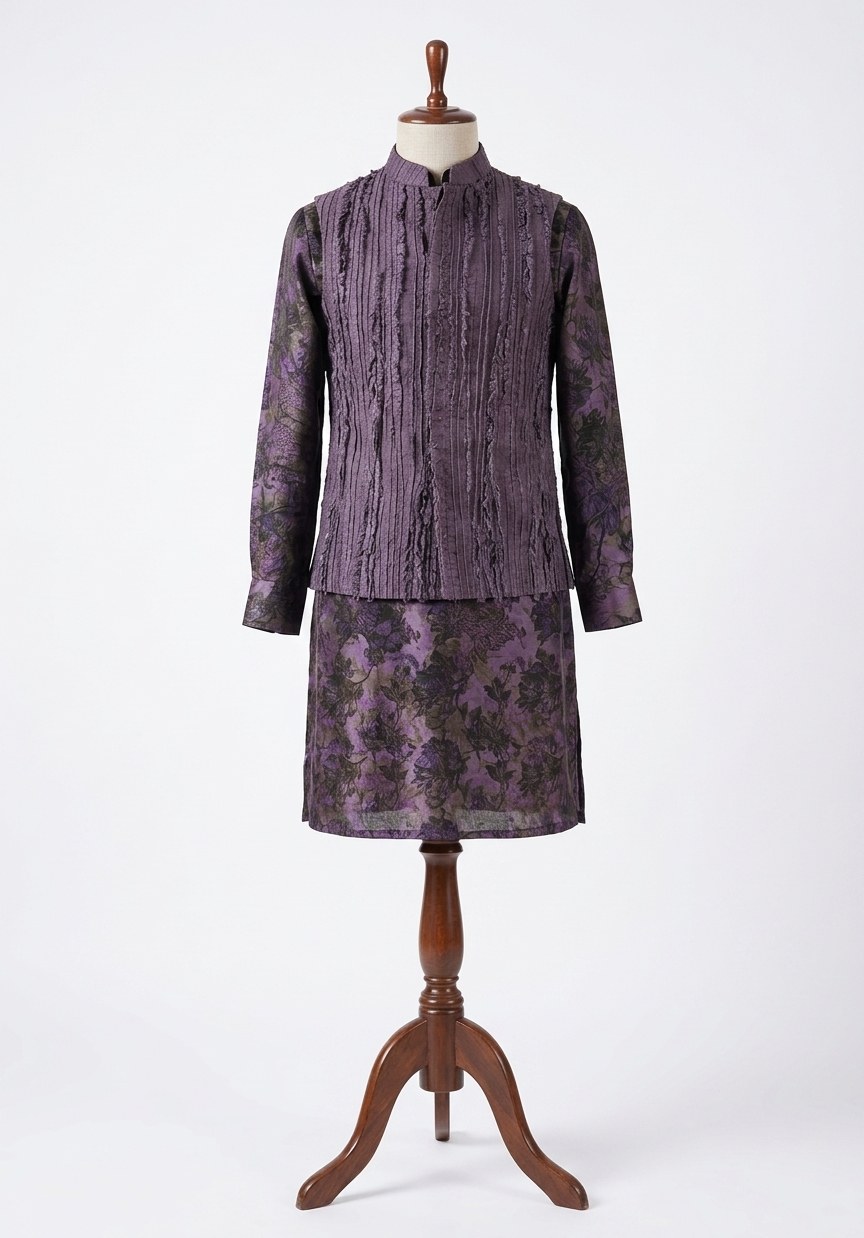
The bandi, called a sadri in much of North India, is a sleeveless close-fitting waistcoat worn over a kurta and either under a sherwani or left as the top layer over a kurta-churidar. It adds formality and interest without committing you to a full jacket, and in Chennai that matters, because a bandi over a fine kurta is bearable in April in a way a sherwani simply is not. It's the wedding guest's garment, the sangeet garment, the Diwali garment. Made at Sellers in silk, brocade or suiting wool, cut to your measurements and in the colour your particular function calls for.
What the bandi does in an ethnic outfit
Think of the bandi as the Indian waistcoat: a layer that adds shape and formality without the warmth or the weight of a full jacket. Over a plain silk kurta in a neutral tone, a brocade or worked bandi carries all the occasion-specific decoration while leaving the kurta free to be worn again with something else. Over a fine white kurta, a navy or charcoal suiting bandi reads almost like Western formalwear while staying Indian in its cut.
It earns its keep hardest for the wedding guest who wants to be properly dressed without turning up in a full sherwani, which on anyone other than the groom or the immediate family looks like a misjudgement. A cream silk kurta under a well-worked bandi in a complementary colour puts you exactly where you should be in the visual pecking order of the day, dressed well and clearly below the groom.
How we cut and build a bandi that closes cleanly
A bandi lives or dies on the chest and the waist. It fastens down the front with buttons, a zip hidden behind a fly, or hook-and-bar closures, and it has to close cleanly, without pulling across the chest and without gaping open the moment you turn. The armhole decides both comfort and looks: cut it too large and the bandi hangs shapelessly, too small and you cannot lift your arms for the aarti.
At Sellers we cut a bandi fitted but not tight through the chest, with a defined waist and a hem that finishes at the hip seam of the kurta, usually 2 to 4 cm below the natural waist. We set that length at the fitting with the kurta on you, because the relationship between the two garments is the whole point and it cannot be judged on a hanger.
Cloth and occasion, from Diwali to the wedding mandap
Brocade in gold or silver zari over a silk ground is the traditional wedding bandi. The weave supplies the decoration and the cut supplies the shape, and between them nothing else is needed. A full brocade bandi over a plain cream or ivory silk kurta is about as complete as a festive outfit gets without a sherwani, and it is a good deal more comfortable in a Chennai mandap.
Raw silk in a complementary colour, deep teal over cream, warm burgundy over champagne, navy over white, gives you a festive bandi without the full weight of brocade. That is the right register for family functions, sangeets, Diwali and Eid evenings, and smaller weddings where brocade would be shouting.
If the occasion is a corporate evening or a formal reception with a quieter dress code, a fine suiting wool in charcoal or navy makes a bandi that is Indian in construction and entirely sober in effect. Several of our regulars own exactly this and wear it far more than they expected to.