
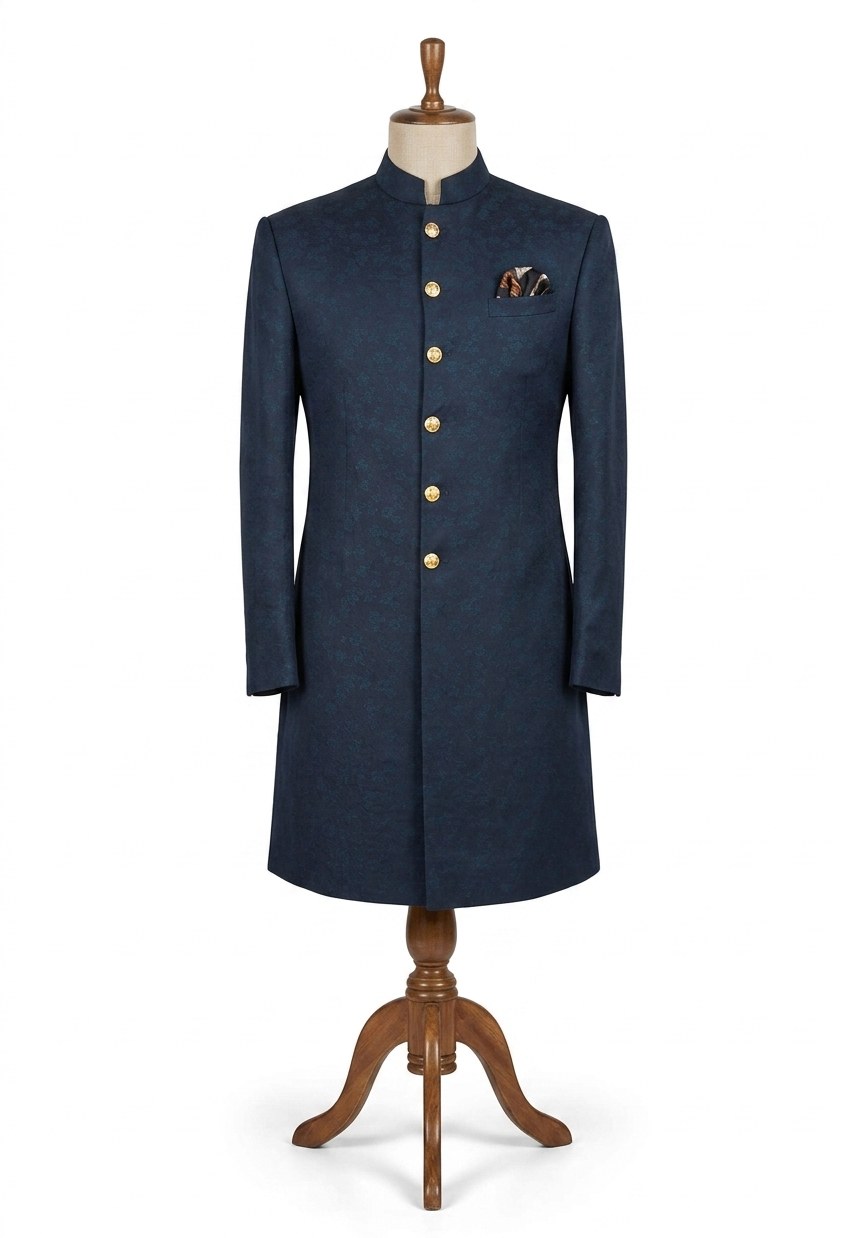
An achkan is a long coat worn over the kurta and churidar. It's a close relation of the sherwani, but it's built rather than decorated: more structure inside, more shaping through the body, closer in its construction to a Western coat while staying unmistakably Indian in outline. Where a sherwani leans on rich cloth and embroidery, an achkan leans on the cutting. That makes it the more demanding garment to make and, for the right man, the more satisfying one to wear. We make achkans at Sellers in fine suiting wools, silk blends and raw silk.
Achkan or sherwani: how they differ
They're cousins, and they're not the same coat. An achkan is built with canvas and internal structure much like a Western coat, so it holds a shape of its own. A sherwani is usually made with less structure and lets the cloth and the embroidery do the talking. An achkan tends to be cut in plain or lightly patterned cloth with restrained work; a sherwani is far more often brocade or heavily embellished.
What you end up with is a coat that reads as architectural rather than ornamental. If you want the authority of a full-length coat without the decoration, or if you like the precision of Western tailoring and want it expressed in an Indian garment, the achkan is the one to order.
When to wear an achkan, and who it suits
An achkan is correct at any formal Indian occasion. Grooms choose it when they want the presence of a long coat without a brocade sherwani's ornament, which suits an understated man and suits a ceremony with Western elements. In a fine ivory or cream raw silk, an achkan needs no embroidery at all to look finished, and in a Chennai June it's a great deal more wearable than the alternative.
If you're not the groom, an achkan at a wedding marks you out as someone who understands Indian formal dress. It's less common than a sherwani on the groom or a bandhgala on a guest, and that rarity gives it a quiet distinction. You'll be noticed without having done anything loud to earn it.
How we build an achkan, and what we build it from
An achkan at Sellers is made with a full canvas, the same construction we use in our best Western coats. That's what lets it hang correctly from the shoulder through the entire length of the body instead of collapsing at the waist. Most ready-made achkans are fused or barely structured, and you can see the difference from across a room after an hour of wear.
For cloth, fine raw silk is the traditional choice. Suiting wools work for professional and political settings, and silk-wool blends give you the hand of silk with more structure and better recovery. The standing collar is cut as a separate band with its own pattern and gets set at the first fitting, because collar height and collar fit are the most visible things on a finished achkan and the hardest to correct afterwards.